


Baccarat Tie Bet 2026 - 8:1 vs 9:1 Odds and House Edge
The highest payout on the layout, and the most expensive bet on it. Here is the arithmetic.
We earn a commission on some links on this page. It is one input to the order, and it never changes the figures shown. Every operator on our board is listed as licensed by the UK Gambling Commission, so GAMSTOP self-exclusion covers them.
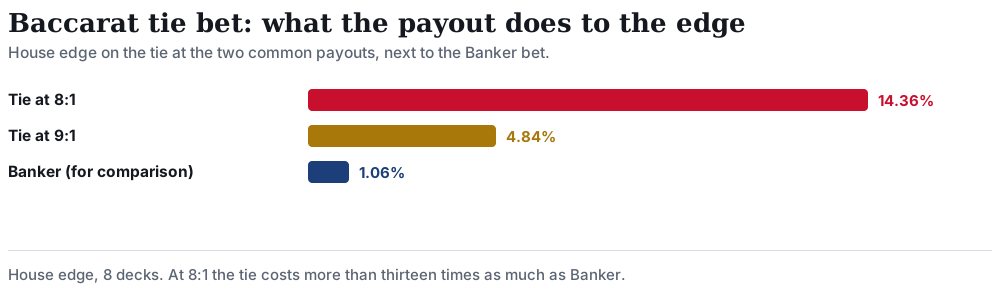
The baccarat tie bet is a wager that both hands finish on the same total, and most tables pay it at 8 to 1. A tie lands about once in ten and a half hands, which sounds generous until you price it: the house edge is 14.36%, over thirteen times the cost of Banker. Below are the tie odds, the rarer 9 to 1 tables, the "for" and "to" wording trap, what a tie does to your other bets, normal gaps between ties, and the English Egalite bets.
Baccarat tie bet: what it is and how it settles
The tie has its own strip on the layout, usually a narrow band above the Player and Banker boxes printed with the words "Tie pays 8 to 1". It wins when both hands finish level once every card has been dealt: 0 against 0, 5 against 5, 9 against 9. Any other result loses it. Most people find that strip a few minutes after signing up at one of the baccarat sites uk players use, and the questions are always the same: how often does it come in, what does it really pay, and is it worth a chip.
Nobody chooses whether a tie happens. The cards follow fixed drawing rules and neither you nor the dealer makes a decision, so a tie is purely an accident of the order of the shoe. If you want the full round explained from the first card, our guide to how to play baccarat covers it step by step. This page stays on the one wager with the biggest payout on the table and the worst value.
Tie bet payout: 8 to 1 is the standard
Almost every punto banco table pays the tie at 8 to 1. Stake £10, a tie lands, and you are paid £80 in winnings with your £10 returned, so £90 comes back to you. Wizard of Odds, the reference most mathematicians in this field use, notes that almost all casinos pay 8 to 1 and that a handful have paid 9 to 1. You will see the better price occasionally, and when you do it changes the maths a great deal, as the tables further down show.
What a tie does to your Player and Banker bets
A tie is a push for the two main bets. If you had £20 on Banker and the hand ends 7 against 7, your £20 stays where it is, no commission is taken, and you can leave it or pick it up. The tie wager itself has no push: it either wins at the posted price or loses outright. That asymmetry is why a tie feels like a non-event to most players and a jackpot to a few.
- Hand ends level: Tie bet wins at 8 to 1 (or 9 to 1), Player and Banker bets are returned untouched.
- Player wins: Tie bet loses, Player pays 1 to 1, Banker loses.
- Banker wins: Tie bet loses, Banker pays 1 to 1 less 5% commission, Player loses.
- Both a tie and a main bet placed: on a tie you collect the tie winnings and keep the main stake; on any other result you lose the tie stake whatever happens to the main bet.
How ties come about under the drawing rules
Ties are more common at some totals than others because the drawing rules push hands towards particular numbers. Both hands stand on 6 or 7 in many situations, and the Banker's draw depends on the Player's third card, which is why level totals cluster in the middle of the range. If you want to see exactly when each side draws, the baccarat third card rule page sets out the full tables. For the tie bettor the practical point is simpler: you cannot see any of this coming, because the decisions are automatic and the next card is hidden.
Baccarat tie odds: how often a tie lands
In a standard eight-deck shoe the chance of a tie on any single hand is 9.52%. Put another way, a tie lands on average once every 10.5 hands. Wizard of Odds gives the exact figure as 9.5156% for eight decks, 9.5069% for six and 9.3615% for a single deck, so deck count barely moves it. The two other outcomes split the remainder: Banker wins 45.86% of hands and Player 44.62%.
Averages hide how lumpy ties are in practice. Because each hand is close to independent of the last, ties arrive in clumps and droughts that look meaningful and are not. The table below shows the chance of going a given number of hands with no tie at all, and the chance of seeing at least one.
| Hands played | Chance of no tie | Chance of at least one tie |
|---|---|---|
| 5 | 60.7% | 39.3% |
| 10 | 36.8% | 63.2% |
| 20 | 13.5% | 86.5% |
| 30 | 5.0% | 95.0% |
| 50 | 0.7% | 99.3% |
Read the second row carefully. Even across ten hands, more than a third of the time you will see no tie at all. A run of twenty hands without one happens in roughly one session stretch in seven. None of these droughts makes the next hand more likely to tie.
Ties per shoe
An eight-deck shoe holds 416 cards and a hand uses roughly five of them, and a cut card stops the deal before the end. That leaves somewhere around 70 to 80 hands per shoe, which at 9.52% works out to about seven ties per shoe on average. Some shoes will produce two and others a dozen. Both are ordinary.
Baccarat tie bet house edge: where 14.36% comes from
The house edge is what the casino keeps from each pound staked, on average, over a very long run. For the tie it is easy to work out by hand. Take £1 on the tie at 8 to 1. With probability 0.0952 you win £8; with probability 0.9048 you lose £1. The expected result is 8 multiplied by 0.0952, minus 0.9048, which comes to minus £0.1436 per pound staked. That is the 14.36% edge you will see quoted everywhere. Compare it with the main bets, which our page on baccarat banker vs player prices in detail: Banker and Player cost about a penny in the pound.
A fair price, one where neither side has an advantage, would be about 9.51 to 1. The table pays 8 to 1. The gap between those two numbers is the entire house edge, and because the payout is large and the win rate small, a short gap in price becomes a large percentage.
| Bet | Pays | House edge | Average loss per £10 bet |
|---|---|---|---|
| Banker | 1:1 less 5% commission | 1.06% | £0.11 |
| Player | 1:1 | 1.24% | £0.12 |
| Tie | 9:1 | 4.84% | £0.48 |
| Tie | 8:1 | 14.36% | £1.44 |
Why the tie is the costliest main-layout bet
Banker and Player are both priced within a whisker of fair. The tie is not. Its 14.36% edge is about 13.5 times the Banker figure and about 11.5 times the Player figure. Every £100 you push through the tie box costs £14.36 on average, against £1.06 on Banker. The pair and bonus wagers printed beside it are priced differently again, and our page on baccarat side bets ranks each of them by house edge.
Deck count and the tie edge
Fewer decks make the tie slightly worse, because ties become a touch rarer. Wizard of Odds puts the 8 to 1 edge at 14.36% for eight decks, 14.44% for six and 15.75% for one. Online and live tables almost all deal from six or eight decks, so the difference is small in practice. Still, a single-deck novelty game is no place for a tie bet.
Baccarat tie at 9 to 1: better, still not good
When a table pays 9 to 1 the expected value per pound becomes 9 multiplied by 0.0952, minus 0.9048, which is minus £0.0484. The edge falls from 14.36% to 4.84%, cutting the cost by about two thirds. That is a real improvement and worth knowing about. It is also still roughly four and a half times the cost of Banker, so a better tie is still a worse bet than either main wager.
If you only enjoy baccarat with an occasional long-shot in play, a 9 to 1 table is the place to have it. If you are trying to make your money last, it changes nothing about which bet to back. The baccarat odds page sets every wager on a standard table against the same yardstick, and the tie sits at the bottom whichever price it carries.
Baccarat tie wording: "8 to 1" against "9 for 1"
This is the trap that catches people comparing tables. "To" and "for" mean different things. A payout of 8 to 1 means you win £8 for each £1 staked and keep your £1, so £9 comes back. A payout of 9 for 1 means £9 comes back in total, stake included, which is exactly the same thing as 8 to 1. Wizard of Odds notes that the standard tie is often expressed as 9 for 1.
So a table advertising "Tie 9 for 1" is not the generous 9 to 1 game. It is the standard 8 to 1 game described in a way that sounds better. The only way to know is to open the table's info or paytable panel and read the wording, or stake the minimum once and check what the balance does.
- 8 to 1 or 8:1: standard, 14.36% edge on eight decks.
- 9 for 1: the same standard price, worded differently.
- 9 to 1 or 9:1: the better price, 4.84% edge.
- 10 for 1: identical to 9 to 1.
Tie bet in baccarat: what it costs over a session
Percentages are abstract, so here is the tie in pounds. Suppose you place 100 tie bets of £5 at 8 to 1. Your total stake is £500 and your expected loss is £71.80. The same 100 bets on Banker would cost £5.30 on average. Over a long evening, that gap is the difference between losing the price of a takeaway and losing the price of a weekend.
How many ties you need to break even
At 8 to 1, each tie returns eight units and each miss costs one. Over 100 bets, eleven ties leave you one unit down (88 won, 89 lost) and twelve put you eight units up. The chance of seeing twelve or more ties in 100 hands is about 24%. So roughly one session in four of that length ends in profit on the tie alone, and three in four end behind, with the losers losing more on average than the winners gain. Staking plans promise to tilt that ratio, and our page on baccarat betting systems shows why none of them can.
Volatility: why the tie feels exciting
The standard deviation of a single 8 to 1 tie bet is about 2.64 times the stake, against just under one stake for Banker. In plain terms, results on the tie swing far more widely from hand to hand. That swing is what makes a tie win feel dramatic and what makes losing streaks long. It does not change the average; it only spreads the outcomes out around a worse average.
If you play at a pace of, say, 60 rounds an hour with £5 on the tie each round, the expected cost is about £43 an hour. The same pace on Banker costs about £3. Live tables vary in speed, and faster formats raise both numbers in proportion.
Baccarat tie bet myths: streaks, gaps and "due" ties
The commonest mistake with the tie is treating a long gap as a sign that one is coming. It is not. A shoe has no memory in any useful sense, and twenty hands without a tie, which the table above shows happens about 13.5% of the time, tells you nothing about hand twenty-one. The same goes for the reverse: two ties in a row do not mean the shoe is "tie-heavy".
Live tables show the history of the shoe on the bead plate and the road maps, and ties are usually marked as small green slashes. Those records are accurate history, not forecasts. Our page on the baccarat scoreboard explains how to read each road and why none of them predicts the next result.
Can you count cards for the tie?
In theory the composition of the remaining cards nudges the tie's chances up and down. In practice the effect is far too small to overcome a 14% edge. Wizard of Odds worked out what happens in the most extreme case, where a careless dealer flashes the very next card: even then, the best case (a 6 or 7 showing) still leaves the tie with about a 3.4% disadvantage. You will never have that information legitimately, and tracking the shoe by eye at a live table gets you nowhere near it.
Progressions on the tie
Some players chase the tie with a progression, raising the stake after each miss so that one win recovers everything. The arithmetic of a 14.36% edge applies to every pound in the progression, so the expected loss grows with the stakes, and the long droughts shown above can push a progression into table limits quickly. No staking plan alters the edge on a single pound.
Baccarat tie variants: Egalite and specific-tie bets
Some tables, and Wizard of Odds says they are most likely to be found in casinos in England, offer Egalite bets: wagers on a tie at one particular total rather than any tie. Because each is far rarer, the payouts are much higher. The pays and edges below are Wizard of Odds figures for the full ten-bet version.
| Tie on | Pays | House edge |
|---|---|---|
| 0 and 0 | 150 to 1 | 12.45% |
| 1 and 1 | 215 to 1 | 11.42% |
| 2 and 2 | 225 to 1 | 9.54% |
| 3 and 3 | 200 to 1 | 10.52% |
| 4 and 4 | 120 to 1 | 12.14% |
| 5 and 5 | 110 to 1 | 11.87% |
| 6 and 6 | 45 to 1 | 11.50% |
| 7 and 7 | 45 to 1 | 6.39% |
| 8 and 8 | 80 to 1 | 11.07% |
| 9 and 9 | 80 to 1 | 10.63% |
The 7 and 7 bet stands out at 6.39%, cheaper than the ordinary tie at 8 to 1 though still six times the Banker edge. Pays vary between casinos, and some group the totals together, so treat this table as a guide to the shape of these bets rather than a promise of what your table offers.
Baccarat tie bet: when, if ever, it makes sense
Strictly on the numbers, never: there is always a cheaper bet on the same table. But people play baccarat for enjoyment as well as value, and a small tie stake can be a deliberate choice rather than a mistake, provided you know what it costs.
- Keep the tie stake small relative to the main bet, a tenth or less, so it cannot dominate your losses.
- Read the paytable first and prefer a genuine 9 to 1 table if you want the tie in play.
- Decide the tie budget for the session before you sit down and stop when it is gone.
- Never increase the tie stake because one has not landed for a while.
- Check bonus terms before using bonus funds on it; many offers weight table games low or exclude some bets.
Set deposit and time limits in your account before you play, and if baccarat stops being fun, GAMSTOP lets you exclude yourself from every UKGC-licensed online operator at once. The National Gambling Helpline, run by GamCare, is free and open 24 hours on 0808 8020 133.
Baccarat tie bet: common questions
What does a tie pay in baccarat?
The standard payout is 8 to 1, so a £10 tie bet returns £90 including your stake. A few tables pay 9 to 1. Check the wording, because "9 for 1" is the same as 8 to 1.
How often does a tie happen in baccarat?
About 9.52% of hands in an eight-deck game, or roughly one hand in 10.5. That averages out to around seven ties per shoe, but the real number varies widely from shoe to shoe.
What happens to my Banker or Player bet on a tie?
It pushes. Your stake is returned in full and no commission is charged on Banker. Only the tie wager is settled on a tied hand.
What is the house edge on the tie bet?
At 8 to 1 it is 14.36% on eight decks, the worst of the three main bets by a wide margin. At 9 to 1 it falls to 4.84%, which is still several times the Banker edge of 1.06%.
Is a tie due after a long run without one?
No. Each hand is effectively independent, so twenty hands without a tie, which happens about one time in seven, does not make the next hand any more likely to tie.
Is the tie bet ever a good idea?
Not on value: Banker and Player are always cheaper. If you enjoy having a long shot in play, keep the stake small, look for a genuine 9 to 1 table and set a budget for it in advance.
What is an Egalite bet?
A bet that the hand will tie on one specific total, such as 7 and 7. Pays run from 45 to 1 up to 225 to 1 and the house edges range from about 6% to 12%, so they are long shots with costs to match.