


Baccarat Card Counting 2026 - The Research and the Real Edge
Yes, the cards left in the shoe matter. No, not enough to pay for your coffee.
We earn a commission on some links on this page. It is one input to the order, and it never changes the figures shown. Every operator on our board is listed as licensed by the UK Gambling Commission, so GAMSTOP self-exclusion covers them.
Baccarat card counting is possible in the strict sense that the cards already dealt change the odds on the next hand. The question is by how much. Drawing on the published work of Edward Thorp and William Walden in the 1960s and on Michael Shackleford's effects of removal tables at Wizard of Odds, this page shows what a count actually achieves on Banker and Player, what that is worth in pounds, where side bets behave differently, and why an eight-deck shoe on a UK live table leaves a counter with nothing worth having.
Baccarat card counting: the short answer
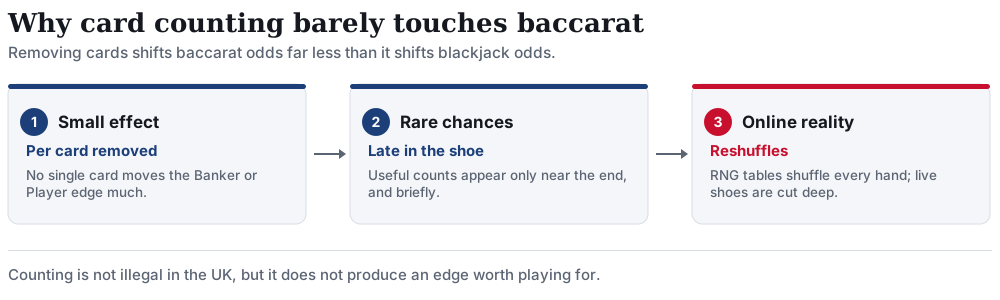
Counting cards at baccarat can cut the house edge on the main bets from about 1.06% to about 1.01%. It cannot turn it into a player advantage. That is the conclusion of the best known modern analysis, and it matches what mathematicians found when they first looked at the game sixty years ago.
For anyone comparing baccarat sites uk on the hope that a count will tip the balance, that settles it before you start. The edge falls by about five hundredths of a percentage point, you keep losing, and you have to track every card in an eight-deck shoe to get there.
Counting fits into the larger baccarat strategy picture as a curiosity rather than a tool. The rest of this page shows why, with the numbers, so you can judge the claims you will meet elsewhere.
Card counting in blackjack versus baccarat: why one works
Blackjack counting works for two reasons that baccarat lacks. First, the player gets paid 3:2 for a natural, and a shoe rich in tens and aces produces more naturals. Second, the player makes decisions: stand, hit, double, split. A count tells a blackjack player both when to raise the stake and how to play the hand, and those decisions compound into a real edge for a skilled counter. The wider comparison of the two games, from house edge to pace, is on our baccarat vs blackjack page; here the only question is the count.
Baccarat gives you no decisions at all beyond the bet. Both hands are played by fixed drawing rules, and a rich or poor shoe helps Banker and Player in roughly equal and opposite measure. When a card helps one side it hurts the other by almost the same amount, so the information only ever tells you which of two losing bets is losing slightly less at that moment.
Why counting cards barely moves an eight-deck baccarat shoe
An eight-deck shoe holds 416 cards. Removing one card from that pile shifts the main bets by between a few thousandths and about a hundredth of one per cent. Even a strongly unbalanced shoe late in the deal, with dozens of cards missing in one direction, moves the Banker and Player edges by tenths of a point at most, and those moments are rare.
Baccarat card counting by the numbers: effects of removal
The standard way to measure this is the effect of removal: how much the expected value of a bet changes when one card of a given rank is taken out of a full shoe. Wizard of Odds publishes the table for eight decks. The figures below are its numbers, converted to percentage points.
| Rank removed | Banker bet | Player bet | Tie bet |
|---|---|---|---|
| Ten or picture (0) | +0.0019 | -0.0018 | +0.0513 |
| Ace | +0.0044 | -0.0045 | +0.0129 |
| 2 | +0.0052 | -0.0054 | -0.0239 |
| 3 | +0.0065 | -0.0067 | -0.0214 |
| 4 | +0.0116 | -0.0120 | -0.0292 |
| 5 | -0.0083 | +0.0084 | -0.0264 |
| 6 | -0.0113 | +0.0113 | -0.1160 |
| 7 | -0.0083 | +0.0082 | -0.1091 |
| 8 | -0.0050 | +0.0053 | +0.0654 |
| 9 | -0.0023 | +0.0025 | +0.0426 |
Three things stand out. The biggest single effect on Banker, from a 4, is about a hundredth of a percentage point. Banker and Player move as near mirror images, so whatever you gain on one you would lose on the other. And the Tie bet moves far more, with 6s and 7s the cards that matter, but it starts from an edge of 14.36% at 8:1, which no realistic shoe can overturn.
If you want those base edges explained from scratch, including why Banker pays commission, our baccarat odds page builds them up hand by hand. Card counting only nudges them; it starts from exactly those numbers.
Low cards favour Banker when counting cards
The pattern behind the table is simple enough to remember. Removing low cards, ace to 4, helps Banker. Removing 5 to 9 helps Player. The reason sits in the drawing rules: Banker draws or stands depending on Player's third card, so a shoe that has lost its small cards changes how often Banker's flexible drawing pays off. The full drawing chart is on our baccarat third card rule page.
How lopsided a shoe card counting would need
A useful test of any counting claim is to ask what the shoe would have to look like for Banker to become a winning bet. Adding up the Wizard of Odds effects in a straight line gives a rough answer. Each 4 removed is worth about 0.0116 points to Banker, and an eight-deck shoe holds 32 of them. Take out every single 4 and Banker improves by about 0.37 points, leaving it still well short of break-even.
Go further and remove every ace, 2, 3 and 4 in the shoe, all 128 of them, with nothing else dealt. The straight-line estimate puts the improvement at about 0.89 points, which still does not cover the 1.06% edge. Player fares no better: stripping out all 128 cards from 5 to 8 helps it by about 1.06 points against a starting edge of 1.24%.
Real shoes never get anywhere near those extremes, because cards come out in a mix and the cut card stops the deal with plenty left. Straight-line estimates also lose accuracy at extremes like these, so treat the figures as an illustration of scale rather than exact values. The scale is the point: even an impossible shoe barely gets the main bets to level.
A card counting system for baccarat: the plus-minus count
Wizard of Odds turns those effects into a practical count. It is about as simple as counts get.
- Start each new shoe at zero.
- Add one for every ace, 2, 3 and 4 you see.
- Subtract one for every 5, 6, 7 and 8.
- Ignore tens, pictures and 9s.
- Bet Player when the running count is minus four or lower; otherwise bet Banker.
Played that way, the combined house edge across all hands is 1.01%, against 1.06% for betting Banker on every hand. Under that rule you would be backing Player on roughly 28% of hands. The site tested more complex versions of the count too: the second level brings the edge to 1.00% and the third to 1.004%, a gain the author judges not worth the extra effort.
Sitting out hands with a card counting edge
Counting improves a little further if you skip hands when the count is middling. Sitting out every count from minus eight to zero plays about 56% of the hands at an edge of 0.95%. That is the best figure in the analysis, and it is still a house edge. You have simply made fewer losing bets. Note that skipping hands is not the same thing as the staking plans in our guide to baccarat betting systems: it changes when you bet rather than how much, and neither touches the odds on a single hand.
Card counting gain in pounds: what 0.05% is worth
Percentages this small are hard to feel, so here is the same result in money. Assume a flat £10 a hand and a pace of 60 hands an hour, which is £600 staked per hour. Those are illustrative figures, not timings from any table.
| Approach | House edge | Expected loss per hour |
|---|---|---|
| Banker every hand | 1.06% | £6.36 |
| Plus-minus count, level 1 | 1.01% | £6.06 |
| Player every hand | 1.24% | £7.44 |
| Tie at 8:1 every hand | 14.36% | £86.16 |
Perfect counting through a full hour saves about 30p. A single misread card, a moment of distraction or one emotional tie bet wipes that out many times over. Compare it with simply avoiding the Tie, which is worth about £80 an hour at the same stake, and the priorities become obvious.
The same sums apply to any method that claims to read the shoe. Our baccarat scoreboard guide makes the point from the other side: the roads track who won rather than which cards went, so they carry even less information than a count.
Card counting history: Thorp, Walden and the natural side bets
Edward Thorp, the mathematician who proved blackjack could be beaten, turned to baccarat in the 1960s with William Walden. Their 1966 paper in the Journal of the American Statistical Association, "A Favorable Side Bet in Nevada Baccarat", found a winning strategy, but not on Banker or Player. It targeted side bets that paid 9:1 on a natural 8 or natural 9 for either hand, using a count to spot shoes rich in the right cards and sizing bets by the Kelly criterion.
The strategy worked well enough that the casinos withdrew those side bets. In a later paper in 1973, Thorp and Walden set out a general theorem on card counting and applied it to baccarat, concluding that practical favourable strategies did not exist for the tie bet in Nevada baccarat. The pattern established then has held since: the main bets are effectively uncountable, and any edge lives in the side bets.
Why the card counting research still matters
Modern analyses, including the Wizard of Odds work above, reach the same verdict with far more computing power. The figures have barely moved because the game has not. Eight decks, fixed drawing rules and a commission on Banker were enough in the 1960s, and they are enough now.
Card counting on side bets: where the edge can actually flip
Side bets that pay big odds on narrow outcomes are a different animal. Their result depends on a small set of cards, so the shoe's composition swings their value hard. Writing in Global Gaming Business magazine in 2023, table games consultant Bill Zender pointed to the Dragon 7, which pays 40:1 when Banker wins with a three-card 7, and to the Blazing 7s 7-7 tie bet. Off the top of the shoe their house edges are about 7.6% and 7.8%. Citing research by Eliot Jacobson, Zender explained that both can turn positive late in a shoe whose remaining cards favour them.
Zender's conclusion for the main game was blunt: traditional counting cannot beat it, whatever the player's skill or bankroll. Side bets are the exception, which is why surveillance teams watch for players who bet only the Dragon 7 late in a shoe. The full list of those bets and their normal edges is on our baccarat side bets page.
Why side bet card counting fails for most players
Side bet opportunities appear only deep in the shoe, last a few hands, and need a big bet relative to your normal stake to be worth the effort. That pattern of sitting quietly then betting heavily on one long-shot side bet is exactly what a casino looks for. Online, the side bet limits are usually low and the decks deep, so even the theory struggles.
Counting cards online: RNG, live shoes and UK tables
Computer-dealt baccarat ends the discussion. Most RNG versions shuffle the virtual cards after every round, so each hand comes from a full shoe and there is nothing to count. The help file in each game states how it shuffles.
Live tables are closer to a real shoe. The studios behind live baccarat uk tables deal from physical cards, normally eight decks, with a cut card placed well before the end, and some formats use automatic shufflers or swap shoes often. Every one of those practices reduces what a count can achieve, and the starting point was only 0.05 percentage points.
Card counting on live streams: the practical problems
- Cards flash on screen for seconds, and on fast formats the bet window is very short.
- Joining mid-shoe means you have not seen the cards already dealt.
- Stake limits on side bets are typically far lower than on Banker and Player.
- Any tool that reads or counts the stream for you is software assistance, which operators' terms prohibit.
That last point deserves a plain statement. Counting in your head is not cheating. Using a device or a helper to read cards is. In 2022 a group at Marina Bay Sands in Singapore used a hidden earpiece and a spreadsheet on a little-known baccarat variant and took about S$433,730 before they were caught, and members were jailed.
Card counting and the rules: what UK casinos can do
Keeping a mental count is not against the law in Great Britain. It is not, however, a right. Operators set their own terms on how their games may be played and can limit, restrict or close accounts that they believe are using an advantage method, as their terms and conditions allow. In practice the edge on offer at baccarat is so small that counting the main game is unlikely to attract attention at all, because it does not win.
If a strategy you have read promises otherwise, check what it is really proposing. Most "counting systems" sold for baccarat turn out to be staking plans, and a staking plan changes the size of your bets rather than the odds on them.
Many players drift toward blackjack once they learn this, since the decisions there are real and a count can genuinely matter on a hand-dealt shoe.
The useful lesson of the counting research is the reverse of the one sellers draw from it. Baccarat is a game where your choices barely matter beyond two: avoid the Tie, and stake what you can afford to lose. If gambling is becoming a problem, the National Gambling Helpline on 0808 8020 133 is free and open 24 hours.
Baccarat card counting: common questions
Can you count cards in baccarat?
You can, but it barely helps. The best published count lowers the house edge on the main bets from about 1.06% to about 1.01%, which is still a long-term loss. Only certain side bets can swing in the player's favour, and only late in a shoe.
Is card counting in baccarat illegal in the UK?
Counting in your head is not a crime in Great Britain. Casinos can still restrict or close accounts under their own terms, and using a device or software to track cards is cheating.
Why does card counting work in blackjack but not baccarat?
Blackjack gives you decisions and pays 3:2 on naturals, so a count tells you how to play as well as how much to bet. Baccarat hands are played by fixed rules, and a card that helps Banker hurts Player by almost the same amount.
Can you count cards in online baccarat?
Not usefully. Most computer-dealt baccarat reshuffles after every hand, so there is nothing to track. Live tables use real shoes, usually eight decks with a deep cut card, which leaves almost no information to exploit.
Which baccarat bets can be counted?
Side bets that depend on a few specific cards, such as the Dragon 7 and some 7-7 tie bets, can turn positive in a shoe rich in 7s. Banker, Player and the standard Tie cannot be counted into a player advantage in practice.
Did anyone ever beat baccarat by counting?
Edward Thorp and William Walden published a winning method in 1966 for side bets paying 9:1 on naturals, and casinos removed those bets. Nobody has published a practical way to beat Banker or Player by counting.
Does no-commission baccarat change the counting picture?
There is no reason to expect a better result. Banker in no-commission games starts from a higher edge of about 1.46%, and the drawing rules that make Banker and Player move as mirror images are unchanged. A count still cannot produce a player advantage on the main bets.