


Chemin de Fer Baccarat 2026 - Rules, Banco and UK Clubs
The player-banked original: the bank travels round the table, and you get a decision or two.
We earn a commission on some links on this page. It is one input to the order, and it never changes the figures shown. Every operator on our board is listed as licensed by the UK Gambling Commission, so GAMSTOP self-exclusion covers them.
Chemin de fer baccarat, chemmy to generations of British players, is the version where a player holds the bank and it travels round the table like a train, which is one explanation for the French name meaning railway. The casino only deals and takes a fee. This page covers how the rotating bank works, what calling banco means, the draw or stand choice on five, the house cut and the edges, the older baccarat banque, and what British law says about where chemmy can still be dealt.
Chemin de fer baccarat: the game in brief
Chemin de fer uses the same cards and the same scoring as every other baccarat. Picture cards and tens count nothing, aces count one, and only the last digit of a total matters. Two hands are dealt, a third card may follow, and the hand closer to nine wins. Everything else is different, because the money on the table belongs to the players rather than the house.
If you came here looking for a place to play baccarat online rather than the old club game, our guide to baccarat sites uk is the better starting point; chemmy itself is not something you will find in a UK casino app.
One player acts as the banker and puts up a sum of money. The other players, called punters, bet against that bank. The banker deals the Banker hand, a punter plays the Player hand on behalf of everyone betting against the bank, and the croupier runs the table and collects the house's fee from the banker's winnings. For where chemmy sits among its relatives, see our overview of the types of baccarat.
Chemin de fer vs punto banco: who holds the bank
The modern casino game kept chemin de fer's two hands and its scoring, and changed the economics. The comparison makes both games clearer.
| Feature | Chemin de fer | Punto banco |
|---|---|---|
| Who banks | A player, and the role rotates | The casino, always |
| What you bet on | Against the bank, or as the bank | Player, Banker or Tie |
| How the house earns | A fee, typically 5%, on the banker's winnings | 5% commission on winning Banker bets |
| Drawing decisions | A choice on five for the Player hand; two free spots for the banker | None; all drawing is fixed |
| Who handles the cards | The banker deals from the shoe; players turn their own hands | The croupier or software |
| Decks | Usually six, sometimes eight | Usually six or eight |
| Where you find it | Private rooms, some land casinos and members' clubs | Every UK casino floor and online lobby |
The key line is the first one. In punto banco nobody at the table is your opponent; you all bet against the house. In chemmy the punter across the table is the person whose money you are trying to win, and the casino is a referee that takes a cut. That is why the game feels so different in a room even though the cards behave the same way.
Punto banco also shrank well. The single-dealer small table works only because the house banks and the drawing is automatic; a player-banked game cannot be squeezed onto a seven-seat layout run at speed, which is a large part of why chemmy faded from casino floors.
Chemin de fer rules: the shoe, the bank and the coup
Tables traditionally seat up to a dozen or so players around an oval layout, with a croupier in the middle, which makes them nearly twice the size of a seven-seat mini baccarat table. Wizard of Odds notes that the rule books disagree on the shoe: Ian Fleming's account uses six decks and John Scarne's describes eight. Six is the usual figure given elsewhere.
Taking the bank
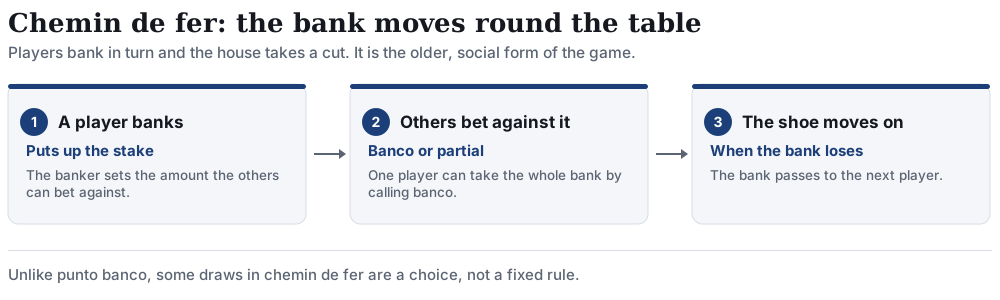
The game starts with one player taking the shoe and announcing the size of the bank, the amount they will stake on the coming round. The punters then cover as much of it as they wish, in turn. If they cover less than the full bank, the uncovered part is simply not in play. If the bank wins, the winnings stay in the bank and the stake for the next round grows, unless the banker chooses to give up the shoe.
Going banco
Any punter can call "banco" to take on the entire bank alone, against everyone else. A banco call takes priority over the smaller bets. Wizard of Odds describes a further priority: a player who went banco and lost the previous round gets first claim to go banco again, a custom often called banco suivi. When someone has called banco, that player plays the Player hand; otherwise it usually falls to the punter with the largest stake.
When the bank moves on
The bank passes when the banker loses a coup. Wizard of Odds describes it moving counter-clockwise to the next player willing to put up at least the previous bank, and a banker can also pass voluntarily after a winning run. House rules on the details vary, so a new player should ask the croupier before sitting down. This movement of the shoe from seat to seat, like carriages along a line, is one popular explanation for the name; Wikipedia gives another, that the variant played faster than the original game.
Chemin de fer drawing: the Player's choice on five
This is where chemmy differs most from the casino game. In punto banco the drawing table is mechanical. In chemin de fer the person playing each hand makes a small number of real decisions, and everyone else's money rides on them.
| Player hand total | Rule in chemin de fer | Same spot in punto banco |
|---|---|---|
| 0 to 4 | Must draw | Draws |
| 5 | Free choice: draw or stand | Draws |
| 6 or 7 | Must stand | Stands |
| 8 or 9 | Natural: turned over at once | Natural |
The free choice on five is the famous one. Wizard of Odds' analysis concludes that drawing is the better play, whatever the banker does, so a well-informed punter treats five exactly as punto banco does. Standing on five costs the punters relying on that hand, since their money rides on the choice. For the full fixed grid the casino game uses, with each line explained, see our page on the baccarat third card rule.
The banker's two free spots
The banker has more rules to follow and fewer choices. Under Scarne's version, if the Player hand stands, the banker draws on 0 to 5 and stands on 6 or 7, just as in punto banco. If the Player hand draws, the banker follows a table based on its own total and the Player's third card, with two situations left open:
- Banker on 3 when the Player's third card is a 9.
- Banker on 5 when the Player's third card is a 4.
Wizard of Odds recommends drawing in both. By its numbers, drawing on 3 against a 9 is the better play by a clear 7.46% of the stake, and drawing on 5 against a 4 by a narrower 0.61%. Both match what punto banco's fixed table does, so the casino game's rules simply hard-wire the best chemmy play.
Chemin de fer odds: what the house takes
Because the bank belongs to a player, the casino cannot rely on a house edge in the usual sense. It takes a fee instead. Scarne describes the house collecting typically 5% of the banker's winnings; Fleming calls the house's share the cagnotte and describes it only as a tiny percentage.
Wizard of Odds has worked out what both sides expect when everyone draws correctly, and the answer is strikingly familiar. Betting against the bank as a punter costs about 1.24% of your stake. Holding the bank, after the 5% fee, costs about 1.06%. Those are, to two decimal places, the Player and Banker edges in eight-deck punto banco. The rotating bank changes who you are playing against, not the price.
So where does the money go? The punters' average loss flows to the bank, which means the bank, before the fee, is a slightly winning position. The croupier's cut on every winning coup takes that gain away and a little more, leaving the banker about 1.06% down. For the probability behind each total and how these figures compare with other casino games, our breakdown of baccarat odds sets them out in full.
The classic game has no separate tie bet. If the two hands tie, the coup is a stand-off and the stakes stay where they are, so the 14.36% trap of the punto banco tie simply does not exist here.
Chemin de fer strategy: the few decisions that matter
Skill in chemmy is real but small. It consists almost entirely of not throwing money away, and it fits in a short list.
- As a punter holding the Player hand: draw on five. Standing gives the bank an extra edge at the expense of everyone backing you.
- As the banker: draw on 3 against a Player third card of 9, and on 5 against a 4. Follow the fixed rules everywhere else.
- Size the bank to your budget. Letting a winning bank roll on means risking all your winnings on the next coup. Decide in advance how many wins you will let run before passing the shoe.
- Watch the fee. The house's cut comes from the bank's wins, so a long, heavily covered bank pays a lot of commission even if it finishes level.
What skill cannot do is turn the game in your favour. Correct play only brings you back to the same edge as punto banco; mistakes push it higher. Card counting gains next to nothing in any form of baccarat, and no staking pattern alters the maths of a single coup. Our guide to baccarat strategy covers what bankroll and bet selection can and cannot do across the whole family.
Chemmy history: from French salons to Ian Fleming
Baccarat reached French society in the nineteenth century, and chemin de fer developed there as the faster, sociable form in which the bank moved round the room. The older baccarat banque survived beside it, while the house-banked punto banco grew up much later; Wikipedia places its origin in Havana in the 1940s.
In Britain the game acquired its nickname and its glamour in the private gaming parties and West End clubs of the post-war decades. Ian Fleming put it at the centre of his first Bond novel: in Casino Royale, published in 1953, Bond's duel with Le Chiffre is fought at a chemin de fer table, not over poker. The 2006 film swapped the game for Texas Hold'em, a sign of how far poker had overtaken chemmy in popular culture.
The decline is easy to explain. A player-banked game needs a table of people with enough money to cover one another, a skilled croupier, and a casino willing to earn a fee rather than an edge. Punto banco needs none of that, and it can be dealt to one player or thousands. Even Crockfords in Mayfair, opened in 1828 and long a byword for high-stakes card play, closed its doors in 2023, according to Time Out.
Chemin de fer online: why there is no real table
We have not found a genuine player-banked chemin de fer game at any UK-licensed online casino, and the absence is structural rather than an oversight. A real chemmy table needs players banking against each other, with the house taking a fee. An online casino banks every game it offers, and a single-player RNG screen has nobody to pass the bank to. The closest substitute is a studio table, and our hub on live baccarat uk explains how those work and how their formats differ.
If a game online uses the name, open its rules page before you stake anything. It may simply be punto banco in period dress, which is fine as long as you know it.
At a live dealer table a real croupier deals from a physical shoe and other players bet on the same hands. Squeeze tables in particular recreate some of the slow, tense reveal that chemmy is remembered for. The bank will always be the house's, and the edge will be the punto banco edge you have read about above.
Chemin de fer and baccarat banque: the fixed-bank sibling
Baccarat banque, often just called banque, is the closest relative of chemmy and the oldest of the three surviving forms. The main difference is that the bank does not rotate. One banker holds it for a long run, and plays against two Player hands, one dealt to each half of the table, with the punters on each side backing their own hand.
Wikipedia describes two versions. In banque limitée, the casino game, an employee of the casino holds the bank and three decks are used. In banque ouverte, the no-limit form, the shoe holds six decks. The house's cut is a small levy on the bank.
Banque is now very rare. We have found no UK online casino offering it, and if you want to play it in a land casino, the only reliable approach is to ask in advance.
Chemin de fer in the UK: the law and where chemmy is dealt
British law gives chemmy an unusual place. The Gambling Act 2005 (Club Gaming Permits) (Authorised Gaming) Regulations 2007 name two bankers' games that a members' club may offer under a club gaming permit: pontoon and chemin de fer. The same regulations cap the participation fee at £3 per day. The reason is the rotating bank. Because the members hold the bank in turn rather than the club, the game can be allowed outside a fully licensed casino.
That does not mean chemmy is easy to find. We have not been able to confirm any British casino currently dealing a regular chemin de fer table, and table rosters change without notice. If you want to play, call the casino or club before you travel and ask three things: whether the game is running, the minimum bank, and the house fee. Any venue offering it must be licensed by the Gambling Commission or hold the relevant permit, and you must be 18 or over.
Online, everything you play at a UK-licensed site is house-banked, so the legal route to chemmy runs only through bricks and mortar.
Whichever form you play, keep it affordable. GAMSTOP excludes you from every UK-licensed online casino in one step, and the National Gambling Helpline on 0808 8020 133 is free, confidential and open 24 hours.
Chemin de fer baccarat: common questions
What is chemin de fer baccarat?
Chemin de fer is the player-banked form of baccarat. One player holds the bank and the others bet against it, the bank moves round the table when the banker loses, and the casino deals and takes a fee from the banker's winnings. It uses the same card values and scoring as punto banco.
What is the difference between chemin de fer and punto banco?
In punto banco the casino banks every bet and all drawing is automatic. In chemin de fer a player holds the bank, the house earns a fee rather than an edge, and the Player hand has a free choice on five. With correct play the costs to each side end up almost identical.
What does banco mean in chemin de fer?
Calling banco means you take on the entire bank yourself, against the banker, rather than sharing it with the other punters. A banco call takes priority, and you then play the Player hand. By custom, a player who went banco and lost often has first claim to go banco again.
Is there any skill in chemin de fer?
A little. The Player hand chooses whether to draw on five, and the banker has two free spots. Drawing in all three cases is the better play according to Wizard of Odds, and getting them right only brings your cost down to the punto banco level rather than below it.
Can I play chemin de fer online in the UK?
We have not found a genuine player-banked chemin de fer game at any UK-licensed online casino. Online casinos bank every game, so chemmy does not fit their model. Live punto banco tables are the closest equivalent.
Is chemin de fer legal in the UK?
Yes. It can be offered by licensed casinos, and the 2007 club gaming regulations name it as one of only two bankers' games a members' club may run under a club gaming permit, with a £3 daily participation fee cap. Finding a table is harder than the law suggests, so ask the venue first.
Why is it called chemin de fer?
Chemin de fer is French for railway. The usual explanation is that the shoe and the bank travel round the table from player to player like a train; Wikipedia records another view, that it was a quicker version than the original game.
Did James Bond play chemin de fer?
Yes. In Ian Fleming's 1953 novel Casino Royale, Bond plays Le Chiffre at chemin de fer. The 2006 film replaced the game with Texas Hold'em poker.