


Baccarat Scoreboard 2026 - How to Read All Five Roads
Five grids, one shoe of history, and not a single forecast between them.
We earn a commission on some links on this page. It is one input to the order, and it never changes the figures shown. Every operator on our board is listed as licensed by the UK Gambling Commission, so GAMSTOP self-exclusion covers them.
A baccarat scoreboard is the set of grids beside every live table that logs the shoe so far: the bead plate, the Big Road and three derived roads called Big Eye Boy, Small Road and Cockroach Pig. This page shows how to read each one cell by cell, works an eleven-hand shoe through all five, and explains the rules the derived roads follow. It also does the sums on streaks and patterns, because the honest answer to what the roadmap tells you about the next hand is nothing at all.
Baccarat scoreboard: what the five roads record
Every hand of baccarat ends in one of three results: Banker, Player or Tie. The scoreboard is simply that result list drawn five different ways. Two of the grids are direct records. The other three are calculated from the second grid and describe its shape rather than who won.
You will meet the full set on most live tables offered by the baccarat sites uk players actually use, usually in a strip under the video, with the bead plate on the left and the Big Road filling the widest panel. Mobile layouts often stack them or hide the derived roads behind a tap.
Before reading any of them, hold onto one fact. Our wider baccarat strategy guide makes the point at length: the only decisions that change your expected result are which bet you make and how much of it. The roads change neither. They are a history book, and a well drawn one.
| Road | What a mark means | Built from | Starts |
|---|---|---|---|
| Bead plate | One hand: red Banker, blue Player, green Tie | Every hand | Hand one |
| Big Road | A win, stacked by streak | Every hand, ties folded in | Hand one |
| Big Eye Boy | Red: Big Road repeating its shape. Blue: not | Big Road, one column back | Second cell of column two |
| Small Road | Same colours, same idea | Big Road, two columns back | Second cell of column three |
| Cockroach Pig | Same colours, same idea | Big Road, three columns back | Second cell of column four |
Bead plate scoreboard: the raw hand-by-hand log
The bead plate is the plainest grid on the screen, and some studios call it the bead road. It is usually six cells deep. Hand one goes in the top left cell, hand two below it, and so on down to the sixth row before the next column starts at the top again. Read it top to bottom, then left to right, like newspaper columns.
Each bead is coloured by result: red for Banker, blue for Player, green for Tie. Many tables print a letter or the winning total inside the bead as well, and a small dot in a corner marks a Banker pair or Player pair when one of those occurred. Nothing is grouped or interpreted. If you want to know exactly what happened on hand 37, this is the only grid that tells you directly.
That makes the bead plate the most useful board for one practical job: checking a result you missed. If your connection dropped mid-round, count along the beads and you can see whether your bet won before the history in the cashier catches up. It is one of the small conveniences of the live baccarat uk tables, where a dropped stream does not stop the dealer.
Big Road scoreboard: streaks, chops and ties
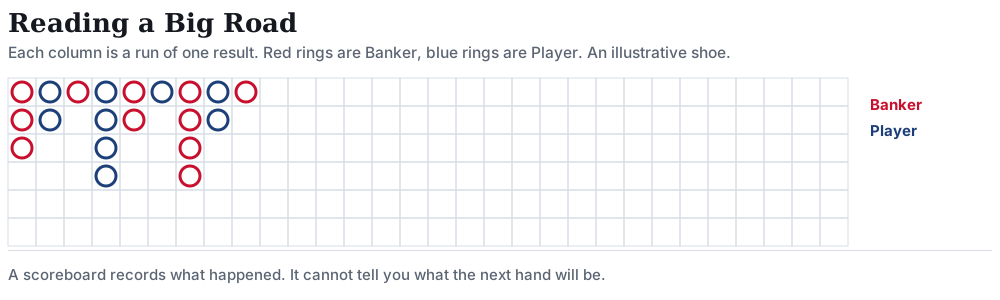
The Big Road is the main grid and the source for everything to its right. It records wins only, and it groups them by streak. Consecutive Banker wins stack down one column. The moment Player wins, a new column begins to the right. A run of five Bankers is one column five cells deep; a strict alternation of Banker, Player, Banker, Player is a row of single cells marching across the top.
Marks are hollow rings rather than solid beads: red for Banker, blue for Player. Ties do not get a cell of their own. Instead a green slash is drawn through the last ring, and a number appears if several ties land on the same spot. A tie on the very first hand of a shoe is shown as a slash in the opening cell before any ring exists. Pairs are shown as small corner dots, as on the bead plate. That slash is easy to miss, and it is the only trace on this grid of the bet our page on the baccarat tie bet covers in full.
Big Road dragon tail: when a column turns right
The grid is six rows deep, so a streak of seven or more cannot keep going down. When a column reaches the bottom, further wins in the same streak turn right along the bottom row. Players call this a dragon tail, and a long one is the most recognisable picture on any scoreboard. If the turn would collide with an earlier tail, the column turns right one row higher instead.
The tail matters only for drawing. For counting, the whole run is still one column, and the derived roads measure it by its full length rather than by the six cells you can see.
Derived roads: how the scoreboard reads its own history
Big Eye Boy, Small Road and Cockroach Pig look like more of the same, with red and blue marks in a grid. They are not. On these three, red and blue have nothing to do with Banker or Player. Red means the Big Road is behaving like itself a little earlier in the shoe. Blue means it has broken from that shape. Players often shorten this to "orderly" and "choppy". If the real question on your mind is which side to back, that is answered by the drawing rules and the commission, as our baccarat banker vs player page explains, not by any colour here.
All three use exactly the same rules. The only difference is how far back they look: one column for Big Eye Boy, two for Small Road, three for Cockroach Pig. Call that distance k. The rules are applied each time a new cell appears on the Big Road, once the road in question has started.
- New column on the Big Road. Compare the length of the column just finished with the column k places before it. Same length: red. Different length: blue.
- Same column continues. Look k columns to the left, at the row the new cell has just reached. If that column has a cell at this depth: red.
- Same column, comparison ended one row short. If that column stops exactly one row above the new cell: blue.
- Same column, comparison ended earlier. If that column has nothing at this row or the row above: red, because "both already finished" counts as matching.
Studios draw the three differently so you can tell them apart at a glance. Big Eye Boy usually uses hollow rings, Small Road solid dots and Cockroach Pig short diagonal strokes. Exact styling varies by provider, and a few published guides simplify the continuing rule, so if a mark on your table looks wrong, the game's help file is the reference rather than any website, this one included. Note too that every rule above works on results alone. None of them looks at the ranks of the cards, which is the only shoe information that baccarat card counting can use.
Big Eye Boy road: one column back
Big Eye Boy is the first derived road to appear. It begins with the second cell of the second Big Road column, or with the first cell of column three if column two is a single win. Because it compares each column with its immediate neighbour, it reacts fastest to change. A shoe of steady two-hand streaks turns it solid red; one sudden six-run turns several of its marks blue at once.
Small Road scoreboard: two columns back
The Small Road skips a column. It starts at the second cell of column three, falling back to the first cell of column four if needed, and asks whether today's column resembles the one two places earlier. Its marks are therefore a little slower to flip than Big Eye Boy's, and its grid is shorter because it starts later.
Cockroach Pig on the scoreboard: three columns back
The Cockroach Pig, sometimes called the Cockroach Road, compares with the column three places back and starts at the second cell of column four. It is the last to begin and the shortest grid on the board. There is nothing special about stopping at three. The same rule could run four or ten columns back; tradition settled on three, mainly because a fourth grid would not fit on the felt.
Scoreboard worked example: eleven hands through all five roads
Here is a short shoe, invented for illustration rather than taken from any table: Banker, Banker, Banker, Player, Player, Banker, Player, Player, Player, Banker, Banker. No ties, to keep it clean.
The bead plate shows those eleven results in order down the first column and into the second. The Big Road groups them into five columns: three Bankers, two Players, one Banker, three Players, two Bankers. Every derived mark below comes from those five column lengths, 3, 2, 1, 3 and 2.
| Big Road cell | Big Eye Boy | Small Road | Cockroach Pig |
|---|---|---|---|
| Column 2, row 2 (Player) | Red: column 1 reaches row 2 | Not started | Not started |
| Column 3, row 1 (Banker) | Blue: 2 against 3 | Not started | Not started |
| Column 4, row 1 (Player) | Blue: 1 against 2 | Blue: 1 against 3 | Not started |
| Column 4, row 2 | Blue: column 3 ended one row short | Red: column 2 reaches row 2 | Red: column 1 reaches row 2 |
| Column 4, row 3 | Red: column 3 ended earlier | Blue: column 2 ended one row short | Red: column 1 reaches row 3 |
| Column 5, row 1 (Banker) | Blue: 3 against 1 | Blue: 3 against 2 | Red: 3 against 3 |
| Column 5, row 2 | Red: column 4 reaches row 2 | Blue: column 3 ended one row short | Red: column 2 reaches row 2 |
Look at the last two columns. After the same eleven hands, Cockroach Pig is four reds out of four and the Small Road is four blues out of five. One derived road calls the shoe orderly while its neighbour calls it chaotic, and both are correct, because they are measuring different distances. Anyone who tells you that agreement between the roads is a signal has to explain which road wins when they disagree, which they will do all evening.
Whatever the three grids show, Banker still costs you about 1.06% of each stake over time and Player about 1.24%. Those figures are worked through on our baccarat odds page, and no combination of red and blue moves them.
Baccarat scoreboard patterns: streaks, chops and named shapes
Road readers have a vocabulary for shapes on the Big Road. A streak or dragon is a long single column. A chop or ping pong is Banker and Player alternating, which draws a row of single cells. A double chop is pairs alternating: two Bankers, two Players, two Bankers. Then there are the hybrids: one Banker two Players, the stepped "staircase", and so on.
These names describe the picture well. The trouble starts when they become instructions. "Follow the dragon" says bet the streak continues; "break the dragon" says bet it ends; "play the chop" says keep alternating. Each is a coin-flip call wearing a costume. The staking plans that are usually bolted onto them are a separate topic, covered on our page about baccarat betting systems, and they share the same flaw: they reorganise your stakes without touching the edge.
Why scoreboard patterns appear in every shoe
Long runs feel remarkable, so it helps to know how ordinary they are. Taking ties out, a typical eight-deck shoe gives somewhere around 70 decisions. Treating each as Banker 50.68% and Player 49.32%, the chance that a shoe contains at least one run of five or more of the same side is about 92%. A run of six or more turns up in about two shoes out of three, seven or more in about four shoes out of ten, and even a run of ten appears in roughly one shoe in seventeen.
So the dragon on the board is not a rare event that demands an explanation. It is what randomness looks like when it is drawn as columns. A grid that showed no long streaks across a whole evening would be the odd result.
Scoreboard maths: why the next hand ignores the roads
The chance of the next result depends on the cards left in the shoe, not on the order in which earlier cards fell. The roads record order and discard almost everything about composition, so they carry close to no information about the next deal. Banker still wins about 45.86% of hands, Player about 44.62% and Tie about 9.52%, whatever the grid looks like.
Card removal does shift those numbers very slightly as a shoe is used up, and that is the only form of shoe history with any mathematical content. Even there the effect is tiny, far smaller than in blackjack, and the comparison on our baccarat vs blackjack page explains why the same idea pays in one game and not the other. A scoreboard cannot capture it in any case, because a red ring tells you who won, not which ranks were dealt.
The gambler's fallacy behind scoreboard patterns
Two opposite beliefs drive road betting. One says a streak is due to end, so back the other side. The other says a hot side keeps winning, so ride it. They cannot both be right, and in fact neither is. After five Bankers in a row, the sixth hand is Banker about 50.68% of the time when ties are set aside, which is exactly what it would be after five Players.
The house edge follows the same logic. It is set by the drawing rules and the commission, it is identical after a streak and after a chop, and a pattern you spotted ten hands ago has no way to reach it.
Live and RNG scoreboards: what the roads mean on each
On a live table the roads follow a real eight-deck shoe from the shuffle to the cut card. That is why the grids empty when the dealer reshuffles, and why you can join a table halfway through and see the shoe so far. The history is genuine. It is just not useful for prediction.
Computer-dealt baccarat is different. Most RNG versions reshuffle the virtual cards after every round, so a "shoe" in the sense the roads assume does not exist. Where an RNG game does draw a scoreboard, it is logging independent hands from a fresh deck each time. Check the game's help screen to see whether it shuffles every hand.
Scoreboard ask buttons and result counters
Many live tables add two small buttons, often labelled with a B and a P or with "ask". Pressing one shows how each derived road would change if the next hand went that way. It is a drawing preview, nothing more: the table is showing you where the next red or blue mark would sit, not how likely it is.
Above the grids you will usually see counters: totals for Banker, Player and Tie wins, plus pairs, for the current shoe. They are handy for one thing in particular. If ties have not appeared for a while, the counter makes it look as though one is overdue. The tie is still about 9.52% per hand, and the 8:1 version carries a 14.36% edge whatever the counter says.
Using the baccarat scoreboard sensibly
None of this means you should ignore the board. It earns its space in several plain ways, and none of them involves forecasting.
- Confirming a result you missed, using the bead plate.
- Seeing roughly how far through the shoe the table is, which tells you when a reshuffle pause is coming.
- Checking a dispute about a past hand before you contact support, with the hand number in front of you.
- Keeping your own session honest: if you notice yourself waiting for a pattern before betting, that is a cue to step back.
Treat it the way a cricket fan treats a scorecard: a complete, accurate account of what has already happened, read for interest. Baccarat suits people who like a simple bet with no decisions. The roads are the one place baccarat invites you to make a decision that looks like skill. It is the one decision that makes no difference.
If chasing patterns ever stops feeling like a pastime, ring GamCare's National Gambling Helpline (0808 8020 133, free, any hour), and remember that GAMSTOP blocks every UKGC-licensed site at once.
Baccarat scoreboard: common questions
Do baccarat roads predict the next hand?
No. The roads record which side won and in what order, while the next hand depends on the cards left in the shoe. Banker wins about 45.86% of hands and Player about 44.62% regardless of what the grids show.
What do red and blue mean on Big Eye Boy, Small Road and Cockroach Pig?
On the three derived roads, red means the Big Road is repeating the shape it had a set number of columns earlier, and blue means it is not. The colours have nothing to do with Banker or Player on these grids, which is the most common misreading.
How many roads does a baccarat scoreboard have?
Five on a standard live table: the bead plate, the Big Road, Big Eye Boy, Small Road and Cockroach Pig. Some games show only the bead plate and Big Road, especially on small phone screens or in computer-dealt versions.
Should I bet when all three derived roads show the same colour?
There is no mathematical reason to. Agreement between the roads describes how the Big Road has looked, not what the cards will do, and the edge on Banker stays about 1.06% and on Player about 1.24%. Bet only what you were happy to stake anyway.
Why does the Big Road turn sideways?
The grid is six rows deep, so a streak longer than six continues along the bottom row to the right. This is called a dragon tail. It is still counted as one column when the derived roads are calculated.
Where are ties shown on the scoreboard?
On the bead plate a tie gets its own green bead. On the Big Road it is a green slash through the previous mark, with a number if several ties fall in a row. Ties never start a new Big Road column.
Are scoreboards the same on every live baccarat table?
The five roads follow the same conventions almost everywhere, but colours, mark styles and layouts vary by studio and by device. The table's help file describes its own scoreboard and is the reference if a mark looks odd.