


Baccarat Betting Systems 2026 - Worked Sequences in Pounds
Seven staking plans, each run through in pounds, and the one sum that decides all of them.
We earn a commission on some links on this page. It is one input to the order, and it never changes the figures shown. Every operator on our board is listed as licensed by the UK Gambling Commission, so GAMSTOP self-exclusion covers them.
Baccarat betting systems promise order in a game of chance: double after a loss, press after a win, follow a number sequence until the profit arrives. This page takes the best-known progressions one at a time, from the Martingale and Paroli to Fibonacci, D'Alembert, 1-3-2-6 and Labouchere, and works each through a real sequence of bets in pounds, including where a table limit cuts it off. It uses actual baccarat probabilities, shows what the Banker commission does to each plan, and compares them all with plain flat betting.
Baccarat betting systems: what they change and what they never touch
A betting system is a rule for sizing your next stake based on what happened to your last one. It does not choose the bet, read the cards or alter the drawing rules. Before you try one at any of the baccarat sites uk we cover, it helps to know the single sum that governs them all: your expected loss equals the total amount you stake multiplied by the house edge on the bet you are making.
That sum holds whatever order your stakes come in. Banker carries 1.06% and Player 1.24% on an eight-deck shoe, so £1,000 of total stakes on Player costs £12.40 on average whether it went on as a hundred £10 bets or as a frantic Martingale run. A system can make that cost arrive as many small wins and one large loss, or as many small losses and one large win. It cannot make it disappear. Our wider guide to baccarat strategy covers the choices that genuinely affect what you pay.
Negative and positive progressions
Systems fall into two families, and the difference decides how they hurt you:
- Negative progressions raise your stake after a loss: Martingale, Fibonacci, D'Alembert and Labouchere. They win often and lose rarely but heavily.
- Positive progressions raise your stake after a win: Paroli, reverse Martingale and 1-3-2-6. They lose often in small amounts and occasionally hit a bigger win.
- Flat betting keeps the same stake throughout. It is the benchmark everything else should be compared with.
How ties affect a baccarat system
A tie returns Banker and Player stakes, so it counts as neither a win nor a loss. Every worked example below simply ignores ties: you leave the stake where it is and replay the step. The probabilities used are therefore the decided-hand figures, 50.68% for Banker and 49.32% for Player, and the full derivation of those numbers is on our page of baccarat odds.
Baccarat betting systems compared side by side
Here is the field before we take each one apart. Unit sizes in the worked examples are £5 unless stated otherwise, and the table maximum is assumed to be £500, a round figure chosen for illustration rather than any particular casino's limit.
| System | Type | Rule | What a bad run looks like |
|---|---|---|---|
| Martingale | Negative | Double after each loss | Seven losses: £635 down, next bet over the limit |
| Fibonacci | Negative | Next number in 1, 1, 2, 3, 5, 8 after a loss; back two after a win | Eleven losses: £1,160 down |
| D'Alembert | Negative | Up one unit after a loss, down one after a win | Slow drift upwards, long recovery |
| Labouchere | Negative | Bet first plus last number of a line; cross off on a win, add on a loss | Line lengthens, stakes climb |
| Paroli | Positive | Double after a win, bank after three | Lose the base stake, again and again |
| 1-3-2-6 | Positive | Stakes of 1, 3, 2 and 6 units on consecutive wins | Lose one or two units per broken cycle |
| Flat betting | Level | Same stake every hand | Ordinary variance, nothing more |
Every one of these works purely on stake size. None looks at the cards themselves, which is a different idea with its own problems: baccarat card counting tries to read the shoe, and it fails because the shoe gives away too little.
Martingale baccarat betting system: doubling after a loss
The Martingale is the oldest and most dangerous of the baccarat betting systems. You start with one unit, double after every loss, and return to one unit after any win. On an even-money bet, the first win always recovers every previous loss plus one unit. On paper it looks like a machine for printing £5 notes.
A £5 Martingale against a £500 table maximum
Run it on Player, which pays even money, and the stakes climb like this:
| Loss number | Stake | Total lost so far | Result if this bet wins |
|---|---|---|---|
| 1 | £5 | £5 | plus £5 |
| 2 | £10 | £15 | plus £5 |
| 3 | £20 | £35 | plus £5 |
| 4 | £40 | £75 | plus £5 |
| 5 | £80 | £155 | plus £5 |
| 6 | £160 | £315 | plus £5 |
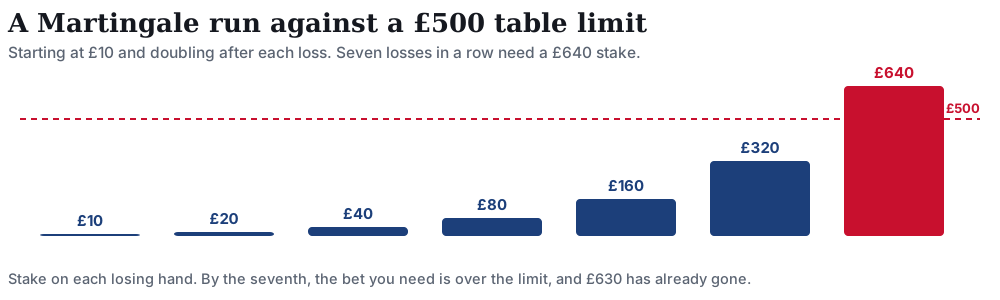
| 7 | £320 | £635 | plus £5 |
| 8 | £640 needed | Not allowed | Sequence over |
After seven straight losses you are £635 down and the next doubled bet is above the £500 maximum. You can no longer recover with a single win, and the system is broken. Every completed sequence before that point paid you just £5.
How often the table limit wins
Seven Player losses in a row, with ties set aside, happen with a probability of about 0.86%, or roughly once in every 116 sequences. That sounds rare until you set it against the payoff: 115 small wins of £5 bring in £575, and one bad run takes £635. Worked exactly, each Player sequence is worth about minus 50p on average, on roughly £36.47 of stakes. That is 1.36% per decided hand, the same 1.24% Player edge once ties are counted. The system changed the shape of the losses and nothing else.
Why the Banker commission breaks the Martingale
Switching to Banker lowers the chance of seven straight losses to about 0.71%, or one sequence in 141. The catch is that a Banker win pays 95p per pound, so a win at a doubled stake no longer recovers everything. The deeper the losing run, the worse the shortfall:
| Losses before the Banker win | Winning stake | Net result of the sequence |
|---|---|---|
| 0 | £5 | plus £4.75 |
| 2 | £20 | plus £4.00 |
| 4 | £80 | plus £1.00 |
| 5 | £160 | minus £3.00 |
| 6 | £320 | minus £11.00 |
So a Banker Martingale can lose money even when it "works". The reasoning behind backing one side or the other is set out on the page about baccarat banker vs player, and nothing in it changes because a progression is running.
Paroli and reverse Martingale baccarat systems: pressing your wins
The Paroli turns the Martingale upside down. You double after a win, not a loss, and you bank the profit after three wins in a row. Any loss sends you back to one unit. The reverse Martingale is the same idea without the three-win stop, which means a single loss eventually returns every penny you pressed.
A £5 Paroli cycle on Player
| Step | Stake | Running total if it wins | Running total if it loses |
|---|---|---|---|
| 1 | £5 | plus £5 | minus £5 |
| 2 | £10 | plus £15 | minus £5 |
| 3 | £20 | plus £35, bank and reset | minus £5 |
The neat feature is that any broken cycle costs exactly one base unit, £5, because you only ever risk the original stake plus money the table has just paid you. Three straight Player wins come up about 12.0% of the time, and three straight Banker wins about 13.0%, though Banker's 95p payouts leave awkward stake sizes that most players round.
Paroli fans like to wait for a streak to "start" before pressing. Streaks are easy to spot afterwards on the baccarat scoreboard and impossible to call in advance, so the waiting adds nothing. The plan's expected cost is still turnover times edge; what it buys you is a capped downside per cycle, which is a real comfort but not an advantage.
Fibonacci baccarat betting system: a slower climb
The Fibonacci system uses the sequence in which each number is the sum of the two before it: 1, 1, 2, 3, 5, 8, 13, 21 and onwards. After a loss you move one step along; after a win you move back two. It climbs more gently than the Martingale, which is its whole appeal.
A worked Fibonacci sequence at £5 a unit
| Bet | Stake | Result | Running total | Next step |
|---|---|---|---|---|
| 1 | £5 | Lose | minus £5 | forward one |
| 2 | £5 | Lose | minus £10 | forward one |
| 3 | £10 | Lose | minus £20 | forward one |
| 4 | £15 | Lose | minus £35 | forward one |
| 5 | £25 | Win | minus £10 | back two |
| 6 | £10 | Win | £0 | back two |
| 7 | £5 | Win | plus £5 | start again |
Four losses and three wins, and you finish a unit up, all on even-money Player bets. Notice how much work it took: £75 staked to make £5. If you want to watch the sequence behave over a few hundred hands without risking anything, free baccarat in demo mode is the place to do it, bearing in mind that UK casinos must verify your age before letting you play even a free game.
Where the Fibonacci meets the table limit
At £5 a unit the stakes run £5, £5, £10, £15, £25, £40, £65, £105, £170, £275 and £445. After eleven straight losses you are £1,160 down and the next bet, £720, is over a £500 maximum. Eleven consecutive Player losses come up roughly once in 1,764 attempts, which sounds remote. The trap is that the Fibonacci does not need an unbroken run to get there: because one win only cancels the last two steps, a choppy shoe with slightly more losses than wins walks the stakes up just as surely.
D'Alembert baccarat betting system: one unit up, one unit down
The D'Alembert adds one unit to your stake after a loss and takes one away after a win, never dropping below the base. It rests on the idea that wins and losses balance out over time, and when they do balance exactly, you come out ahead by one unit for every win.
Six bets of D'Alembert at £5 a unit
| Bet | Stake | Result | Running total on Player |
|---|---|---|---|
| 1 | £5 | Lose | minus £5 |
| 2 | £10 | Lose | minus £15 |
| 3 | £15 | Win | £0 |
| 4 | £10 | Lose | minus £10 |
| 5 | £15 | Win | plus £5 |
| 6 | £10 | Win | plus £15 |
Three wins, three losses, plus £15. Run the identical results on Banker and the commission trims each win, leaving plus £13. The flaw sits in the premise. Wins and losses do not balance in baccarat: Player loses 50.68% of decided hands, and over thousands of bets that small imbalance keeps nudging the stake higher. Reaching a £500 stake from £5 takes 99 more losses than wins, so the limit is rarely the problem here. The problem is that bigger stakes are in play during the losing stretches, which is exactly when you least want them. A fast format such as speed baccarat makes this worse, simply because more hands an hour means the drift builds faster.
1-3-2-6 baccarat betting system: a four-step press
The 1-3-2-6 is a positive progression with a fixed shape. You bet 1 unit, then 3 after a win, then 2 after another win, then 6 after a third, and reset after the fourth bet or after any loss. The drop from 3 to 2 is there to lock in a profit once two bets have landed.
Every outcome of a £10 cycle on Player
| How the cycle ends | Stakes placed | Net result |
|---|---|---|
| Lose the first bet | £10 | minus £10 |
| Win one, lose the second | £10, £30 | minus £20 |
| Win two, lose the third | £10, £30, £20 | plus £20 |
| Win three, lose the fourth | £10, £30, £20, £60 | £0 |
| Win all four | £10, £30, £20, £60 | plus £120 |
Four Player wins in a row happen about 5.9% of the time, and four Banker wins about 6.6%, with the Banker version paying £114 rather than £120 after commission. The common 1-3-2-4 variant cuts the last bet to 4 units, so a full cycle pays £100 and a loss on the final bet still leaves you £20 up. Neither version changes the edge; they just decide which runs pay you and which cost you.
One practical point if you are playing with bonus funds: many offers set a maximum stake while the bonus is active, and the 6-unit step can breach it without you noticing. Check the terms first, and our page on baccarat bonus uk offers explains how game weighting and stake caps usually treat baccarat.
Labouchere baccarat betting system: the cancellation line
The Labouchere, sometimes called the cancellation system, starts with a line of numbers that adds up to the profit you want. Each bet is the first number plus the last. A win crosses both off; a loss adds the amount you lost to the end of the line. When the line is empty, you have made your target.
A 1-2-3-4 line at £5 a unit
The line totals 10 units, so the target is £50. Here is a five-bet run on Player:
| Bet | Line before | Stake | Result | Running total |
|---|---|---|---|---|
| 1 | 1, 2, 3, 4 | £25 | Win | plus £25 |
| 2 | 2, 3 | £25 | Lose | £0 |
| 3 | 2, 3, 5 | £35 | Lose | minus £35 |
| 4 | 2, 3, 5, 7 | £45 | Win | plus £10 |
| 5 | 3, 5 | £40 | Win | plus £50, line cleared |
Why the line runs away from you
Three wins and two losses hit the target, which is why the Labouchere feels efficient. But the run above needed £170 of stakes to make £50, and each loss lengthens the line while pushing the next stake higher. Six straight losses from that 1-2-3-4 start cost £225 and leave ten numbers on the line, with the next stake at £55, eleven times the opening unit. Every further loss lengthens the line again, and the only way out is more stake. Most players abandon the line partway, which locks in the loss the system was supposed to avoid.
Flat betting: the baccarat betting system with nothing to hide
Flat betting means the same stake on every hand. At £10 a hand on Banker for 100 hands, you put £1,000 through the table and your expected loss is £10.60. There is no sequence to track, no limit to fear and no hidden escalation. Your results still swing, sometimes a long way, but the swings come from the cards rather than from your own staking plan.
That makes flat betting the honest yardstick. Any method, from a progression to a count, should be judged by whether it beats flat betting's cost per pound staked, and none of them does. Even counting, which at least uses real information about the shoe, finds too few favourable spots to matter. If you want lower costs, the levers are a smaller stake, fewer hands an hour and the Banker bet.
Why baccarat betting systems seem to work
People who swear by a system are rarely lying about their results. Negative progressions are designed to win most sessions: a £5 Martingale on Player completes more than 99% of its sequences with a profit. A player who runs it for a few evenings and never meets the bad run has, from their own experience, a system that works. The losses arrive less often and much larger, and when one does, it tends to be put down to bad luck rather than to the method.
The only fair test is turnover against loss over a very long run, and the long simulations published by the Wizard of Odds all land on the house edge, matching flat betting. Play a system if its rhythm entertains you, keep the base unit small, and decide in advance what you will do when the table limit arrives.
Baccarat betting systems: common questions
Do betting systems work in baccarat?
No. A system decides how much you stake but cannot change the house edge on each bet, which is 1.06% on Banker and 1.24% on Player. Your long-run loss is total stakes multiplied by that edge, whatever order the stakes come in.
What is the Martingale system in baccarat?
It doubles your stake after every loss and resets after a win, aiming to recover all losses plus one unit. From £5, seven straight losses put you £635 down and the eighth bet of £640 is above a £500 table limit. On Banker, commission means even a successful sequence can finish slightly down.
What is the safest baccarat betting system?
Flat betting, because it never raises your stake to chase a loss. Among progressions, Paroli and 1-3-2-6 cap what a broken cycle costs, but they are lower risk per cycle, not better value.
How much money do you need for a Martingale?
Far more than most players expect. Covering seven losses from a £5 start takes £635, and the table maximum usually ends the sequence before your bankroll does. Either way, the rare bad run cancels out more than a hundred small wins.
What is the 1-3-2-6 strategy in baccarat?
A positive progression where you stake 1, 3, 2 and then 6 units on consecutive wins, resetting after any loss. At £10 a unit, four straight wins pay £120 on Player, but that happens only about 5.9% of the time.
Is betting Banker or Player better with a system?
Banker is still the cheaper bet at 1.06% against 1.24%. The commission makes progressions messier on Banker, but switching to Player to tidy up a system means paying a higher edge for neater arithmetic.
Why do baccarat systems seem to win?
Negative progressions win most sessions by design, then lose heavily on rare bad runs. A player who has not met that run yet sees only the small wins, which is why the systems keep their reputation.