


Punto Banco 2026 - Rules, Payouts and the House Edge
The house-banked baccarat dealt in almost every UK casino, from the shoe to the commission box.
We earn a commission on some links on this page. It is one input to the order, and it never changes the figures shown. Every operator on our board is listed as licensed by the UK Gambling Commission, so GAMSTOP self-exclusion covers them.
Punto banco is the house-banked form of baccarat, and when a UK casino or app says "baccarat" without qualification, this is the game it means. You choose between the Player hand (punto), the Banker hand (banco) or a Tie, and the croupier follows fixed drawing rules that leave nobody a decision. This page covers the shoe and the deal, a round step by step, the payouts written into British regulations, the 5% commission, the house edge of each bet and what a session costs you in pounds.
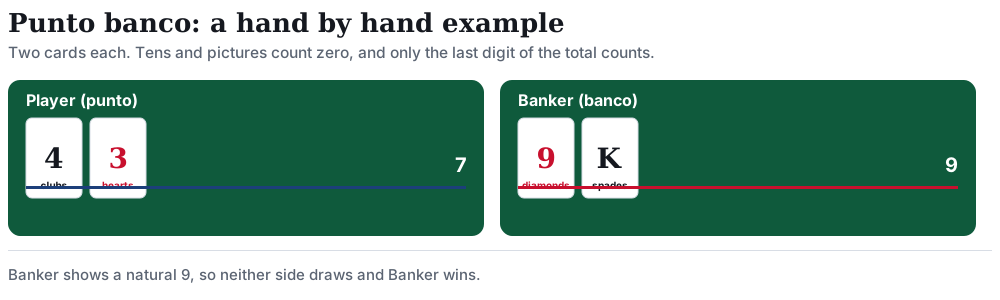
Punto banco: what the name means and who banks
"Punto" is the Player and "banco" is the Banker, and the most useful thing to understand about the game is that neither word refers to a person. The casino banks every wager. Punto and banco are simply the two hands the croupier deals, and you can back either one, or switch every hand, without ever holding the bank yourself.
That sets it apart from older forms of the game, where the banker was a seated player with money at risk. For somewhere to play it, our guide to baccarat sites uk compares the licensed operators.
For how this version fits beside its relatives, from the old player-banked games to the modern commission-free tables, see our overview of the types of baccarat.
Wikipedia traces this house-banked version to Havana in the 1940s, from where it travelled to the casinos of the Americas, Asia and Britain. Today it is the default. Every RNG baccarat title and almost every live studio table you will meet in a UK lobby runs punto banco rules, whatever name sits on the tab.
Punto banco and its relatives: same rules, different tables
Because the house banks and the croupier makes every draw, punto banco can be dealt at any scale without the rules changing. The long high-limit table with a crew of dealers, the midi table where big bettors turn the cards, and the small single-dealer table are all the same game. The small version, mini baccarat, is the one most players meet first, and it differs only in pace, limits and who touches the cards.
The rules do change when the payout changes. Commission-free tables keep the punto banco deal and drawing but pay Banker differently, and that alters the edge. They are covered further down.
The game punto banco replaced is a different animal. In chemin de fer baccarat a player holds the bank, it passes round the table, and players have a little discretion over drawing. Punto banco took the bank away from the players and the discretion away from both hands, which is why it suits a casino floor and a computer screen equally well.
Punto banco rules: card values, totals and naturals
The scoring takes about a minute to learn:
- Aces count as one.
- Twos to nines count at face value.
- Tens, jacks, queens and kings count as zero.
- A hand's total is the last digit of the sum, so 9 and 6 make 15, which counts as 5. No hand can bust.
- The highest possible total is 9, and the hand closer to 9 wins. Equal totals are a tie.
A natural is a two-card total of 8 or 9 in either hand. When either hand shows a natural, nobody draws and the round is settled immediately. A natural 9 beats a natural 8, and two equal naturals tie.
That is all you need to follow a round. You never decide whether to draw. The croupier, or the software, applies the drawing rules for both hands, and the only choice you ever make is where to put your stake before the cards come out.
Punto banco round, step by step
Here is how a hand runs at a standard table.
- The shoe. Six or eight decks are shuffled together and placed in a dealing shoe. Wikipedia notes that a cut card goes in front of the seventh card from the bottom, and when it appears the current hand is the last of the shoe.
- The burn. On most land tables the croupier discards one or more cards face down before the first hand of a new shoe.
- Bets. You place your stake on Player, Banker or Tie, plus any side bets the table offers.
- The deal. Two cards go to each hand, alternating Player, Banker, Player, Banker.
- Naturals. If either hand totals 8 or 9, the round ends.
- Player's third card. Otherwise the Player hand draws on 0 to 5 and stands on 6 or 7.
- Banker's third card. Banker then draws or stands according to its own total and, if Player drew, the value of Player's third card.
- Settlement. The croupier announces the winner, pays winning bets, deducts commission from Banker wins, and returns Player and Banker stakes on a tie.
The Player hand's drawing rule
The Player side is simple enough to memorise: draw on 0 to 5, stand on 6 or 7, and stop on a natural. There are no exceptions and nothing depends on what Banker holds. Banker's side is the complicated one, and our page on the baccarat third card rule sets out its full grid with the reasoning behind each line.
The Banker hand's drawing rule
Banker's rule is where the game gets its shape. If Player stood, Banker follows the same simple rule, drawing on 0 to 5. If Player drew, Banker always draws on 0 to 2, always stands on 7, and on totals of 3 to 6 looks at Player's third card to decide. You never need to memorise it to place a bet, but it explains why Banker wins slightly more often: it acts second, with information Player never has.
A worked round
You put £10 on Player. Player is dealt a 3 and a king, a total of 3. Banker is dealt a 7 and a 9, which makes 16 and counts as 6. Neither hand is a natural, so Player draws, as it must on 3, and receives a 4 for a total of 7. Banker holds 6, and on 6 the rule says Banker draws only if Player's third card was a 6 or a 7. It was a 4, so Banker stands. Player's 7 beats Banker's 6 and your £10 bet returns £20: your stake plus £10 profit.
Had you backed Banker instead, you would have lost £10. Had you backed the Tie, you would have lost that stake too.
Now a shorter one. You put £10 on Banker. Player is dealt a 5 and a 2 for 7; Banker is dealt a queen and an 8 for a natural 8. The round stops there, before Player can draw, and Banker wins. You collect £9.50 profit after commission, and your £10 stake comes back with it. Naturals settle roughly one round in three, which is part of why the game moves so quickly.
Punto banco payouts: Player, Banker and Tie
The three main bets pay as follows on a standard commission table.
| Bet | Pays | £10 winning bet returns | On a tie |
|---|---|---|---|
| Player | 1:1 | £20 (£10 profit) | Stake returned |
| Banker | 1:1 less 5% commission (19 to 20) | £19.50 (£9.50 profit) | Stake returned |
| Tie at 8:1 | 8:1 | £90 (£80 profit) | Wins |
| Tie at 9:1 | 9:1 | £100 (£90 profit) | Wins |
The Banker payout has a British legal pedigree. The Gaming Clubs (Bankers' Games) (Amendment) Regulations 2000 describe a winning Banker wager in punto banco as payable at odds of 19 to 20, which is exactly even money less 5%. Stake £20, win £19.
The Tie is the bet that varies. Wikipedia, citing a Gambling Commission rules document from 2011, says most British land-based casinos pay the tie at 9 to 1, while 8 to 1 is the common figure worldwide. Online and live tables vary, and the gap between the two is enormous in house edge terms. Our page on the baccarat tie bet works through both prices and why the bet is so expensive at 8:1.
Punto banco commission: why 5% and how it is taken
Without the commission, Banker would be a winning bet for you. On an eight-deck shoe Banker wins 45.86% of hands and loses 44.62%, with the rest tied. Paid at even money, that is a player advantage of about 1.24%. The 5% deduction is set at the level that turns Banker into a house bet while still leaving it the cheapest of the three.
How the 5% is collected depends on where you play. Online, the commission is deducted from each winning Banker bet as it is paid, so a £10 win simply shows as £9.50. Some land tables do it differently: rule sheets such as Maryland's allow the dealer either to take the commission at the time of payout or to record it in numbered boxes that match the seats and settle the total later, often at the end of the shoe. If you play in a casino, keep an eye on what you owe before you leave the table.
Casinos have also built versions that drop the commission and make the money back elsewhere, usually by paying half on a Banker win with a total of six. The 2000 regulations already described such a game, under the name Punto 2000. Our page on no commission baccarat shows why that version costs you more on Banker, not less.
Punto banco house edge and probabilities
These are the figures for a standard eight-deck punto banco shoe, with Wizard of Odds values.
| Bet | Probability of winning | House edge, 8 decks | House edge, 1 deck |
|---|---|---|---|
| Banker | 45.86% | 1.06% | 1.01% |
| Player | 44.62% | 1.24% | 1.29% |
| Tie at 8:1 | 9.52% | 14.36% | 15.75% |
| Tie at 9:1 | 9.52% | 4.84% | not quoted |
Two things are worth noticing. First, the number of decks hardly matters for the main bets. Moving from eight decks to one shifts Banker and Player by about five hundredths of a percentage point each, in opposite directions. Second, if you leave ties out, Banker wins 50.68% of decided hands and Player 49.32%. That narrow gap is the whole case for backing Banker, and the commission is the price of it.
For the probability of every total, the tie maths and how these edges compare across the rest of the casino, see our full breakdown of baccarat odds.
Punto banco bets: Banker, Player or Tie
On a standard table the order of preference is clear: Banker, then Player, then nothing else. The Tie at 8:1 is the worst main bet in the game, and most side bets carry edges well above the main ones.
Many players back Player anyway because it pays a clean even money and feels less complicated. That costs about 0.18 percentage points more per hand, which is small but real. Others switch hands to follow the scoreboard, which changes nothing, because each hand is dealt from the same shoe under the same rules and the earlier results do not steer the next card. Our comparison of baccarat banker vs player goes into the commission, the probabilities and the streak myths in more depth.
No betting system changes these numbers. Doubling after a loss, following patterns or flat betting only rearrange when you win and lose; the edge on each hand stays exactly where the table above puts it.
Punto banco in pounds: what a session costs
House edge figures are easier to judge as money. Suppose you stake £10 on every hand for 100 hands, a total of £1,000 wagered. The expected cost, which is the average over many such sessions rather than what will happen tonight, works out like this:
- Banker every hand: about £10.60.
- Player every hand: about £12.40.
- Tie at 9:1 every hand: about £48.40.
- Tie at 8:1 every hand: about £143.60.
The difference between Banker and Player is under £2 per hundred hands at that stake. The difference between either of them and the 8:1 Tie is the price of a good dinner. That is why every serious guide to the game says the same thing about the Tie, and why the choice between the two main bets matters far less than how many hands you play.
Real sessions swing well away from the average. Baccarat is close to a coin toss on the main bets, so a run of ten Banker losses is unremarkable over a long evening. Set a budget you are comfortable losing in full, and treat the expected cost as the fee for the entertainment rather than a forecast.
Punto banco online: RNG and live tables in the UK
Online, punto banco comes in two broad forms. RNG tables deal from a virtual shoe at whatever pace you click, usually with low minimum stakes, and many reshuffle frequently. Live tables stream a real croupier and a physical shoe from a studio, with a betting window of a few seconds before each deal and higher minimums than most RNG games.
Before you play either, open the help or rules screen and check four things: the Banker payout (standard commission or a commission-free rule), the Tie payout (8:1 or 9:1), the number of decks, and the minimum and maximum stakes. Table limits and the exact titles on offer vary between casinos and change often, so check the live casino lobby rather than relying on a review.
Every UK-licensed site must verify your age before you play, including on free demo versions, and none may accept a credit card for gambling. GAMSTOP lets you exclude yourself from all UK-licensed online operators at once, and the National Gambling Helpline is free on 0808 8020 133 at any hour if the game stops being fun.
Punto banco: common questions
What is punto banco?
Punto banco is the house-banked version of baccarat, where the casino covers every bet and you choose between the Player hand, the Banker hand or a Tie. All drawing follows fixed rules, so you make no decisions after the cards are dealt. It is the version dealt at almost every UK casino and online.
Is punto banco the same as baccarat?
It is the most common form of baccarat, and in UK casinos the word baccarat almost always means punto banco. The older forms, chemin de fer and baccarat banque, are player-banked or fixed-bank games with slightly different rules. Mini baccarat is punto banco on a smaller table.
Who is the banker in punto banco?
The casino. Banco is only the name of one of the two hands, and you can bet on it without taking any banking risk. In chemin de fer, by contrast, a player really does hold the bank.
What does a Banker bet pay in punto banco?
Even money less 5% commission, which British regulations express as odds of 19 to 20. A £10 winning Banker bet therefore returns £9.50 profit plus your stake. If the hand ties, your Banker stake is returned.
What is the best bet in punto banco?
Banker, with a house edge of 1.06% on an eight-deck shoe, followed by Player at 1.24%. The Tie at 8:1 carries a 14.36% edge and is best left alone; at 9:1 it improves to 4.84% but is still far dearer than either main bet.
Do you make any decisions in punto banco?
Only where to put your money and how much. The croupier or software applies the drawing rules for both hands, so there is no hit or stand choice as in blackjack. That makes the game easy to learn, but it also means no playing skill can lower the house edge.
How many decks are used in punto banco?
Usually six or eight, shuffled together in a shoe. The deck count makes very little difference to the main bets: Banker's edge moves from 1.06% with eight decks to 1.01% with one. The Tie becomes more expensive with fewer decks.