


Baccarat Odds 2026 - House Edge, Payouts and Hourly Cost
Every baccarat bet priced three ways: as a probability, as a percentage and in pounds per hour.
We earn a commission on some links on this page. It is one input to the order, and it never changes the figures shown. Every operator on our board is listed as licensed by the UK Gambling Commission, so GAMSTOP self-exclusion covers them.
Baccarat odds are among the most generous in any casino, but only if you know which line of the layout you are reading. This page sets out the probability of each outcome in an eight-deck shoe, the payout the casino offers, and the gap between the two, which is the house edge. It then shows how that edge changes with the number of decks and the commission rate, and turns every percentage into an expected loss per hour in pounds at stakes from £2 to £25. Every figure follows the Wizard of Odds analysis.
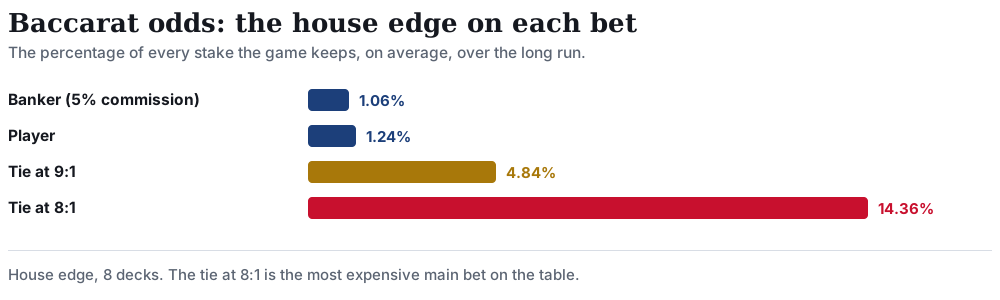
Baccarat odds at a glance: probability, payout and edge
There are three outcomes in a hand of punto banco: the Banker hand wins, the Player hand wins, or they tie. Each outcome has a fixed probability set by the drawing rules and the cards in the shoe, and each bet has a payout set by the casino. Where to find these games is a separate question, answered in our comparison of baccarat sites uk.
This page is the arithmetic underneath the tables, one part of our wider look at baccarat strategy, and it starts with the five numbers every player should know.
| Bet | Probability (8 decks) | Payout | House edge |
|---|---|---|---|
| Banker | 45.86% | 1:1 less 5% commission (0.95:1) | 1.06% |
| Player | 44.62% | 1:1 | 1.24% |
| Tie | 9.52% | 8:1 | 14.36% |
| Tie (some tables) | 9.52% | 9:1 | 4.84% |
| Banker, no commission (6 pays 1:2) | 45.86% | 1:1, or 1:2 on a winning six | 1.46% |
Banker and Player bets are returned when a hand ties, so the edges above already account for those pushes. Read them as the average share of every stake the casino keeps over hundreds of thousands of hands.
Payout odds against true odds
The true odds of an outcome are what a fair payout would be if the casino took nothing. A Tie lands 9.52% of the time, which works out at true odds of about 9.51 to 1. The casino pays 8 to 1. That gap of one and a half units on every winning Tie is the whole of the 14.36% edge. A 9:1 Tie closes most of the gap, which is why its edge falls to 4.84%, but it still pays less than the true price. Our page on the baccarat tie bet looks at when, if ever, either price is worth taking.
Baccarat odds in fractional form
If you are used to a bookmaker's slip, the main bets translate simply. Player pays evens. Banker pays 19/20, which is evens less the 5% commission: a £20 winning Banker bet returns your £20 plus £19. The Tie pays 8/1 or, on some tables, 9/1. In decimal odds those are 2.00, 1.95, 9.00 and 10.00 respectively, each including the returned stake.
Baccarat odds as return to player
Game information screens often quote return to player rather than house edge. The two are the same number seen from opposite sides: subtract the edge from 100% and you have the RTP. That gives the following at a standard eight-deck table:
- Banker with 5% commission: 98.94%
- Player: 98.76%
- Commission-free Banker: 98.54%
- Tie at 9:1: 95.16%
- Tie at 8:1: 85.64%
If a table's help screen shows a different RTP for one of these bets, trust the screen over this page. It means the rules differ from the standard game, usually through a changed payout or commission, and that table's own figure is the one that applies to your money.
Baccarat odds explained: where each edge comes from
Every house edge in the game falls out of one sum: what you win when you win, times how often, minus what you lose when you lose, times how often. Working it through once removes any mystery, and it is the same sum that explains why no staking pattern can help. A sequence of bets is just a collection of individual bets, each with its own negative expectation, which is the point developed at length on our page on baccarat betting systems.
The Banker sum, with commission
Imagine 10,000 hands with £10 on Banker each time. Using the rounded probabilities, Banker wins about 4,586 hands and pays £9.50 each, a total of £43,567. Player wins about 4,462 hands and you lose £10 on each, £44,620 in all. The 952 or so ties cost nothing. You finish around £1,053 down on £100,000 staked, close to 1.05%. The unrounded probabilities give the exact 1.06% in the table; the tiny difference is rounding.
The Player sum, at even money
The same 10,000 hands on Player at £10 is simpler. You win about 4,462 times for £44,620 and lose about 4,586 times for £45,860, with ties again pushing. The net loss is £1,240, which is 1.24% of £100,000. Player pays more per win than Banker, but it wins less often, and the frequency gap outweighs the commission.
The Tie sum, at 8:1 and 9:1
On the Tie there is no push. Over 10,000 hands at £10, about 952 win at £80 each, which is £76,160, and about 9,048 lose, which is £90,480. That leaves you roughly £14,320 down, or 14.32% with rounded figures and 14.36% exactly. Raise the payout to 9:1 and the same 952 wins return £85,680, cutting the loss to about £4,800, or close to the 4.84% shown above.
Baccarat odds with ties set aside
Many players think about baccarat as a straight Banker against Player contest, ignoring the ties because their stake comes back. On that view the split is 50.68% Banker to 49.32% Player. It is a useful way to picture the game, but it changes the edge figures slightly, because the cost is now spread over fewer hands.
| Bet | Edge per hand dealt | Edge per decided hand |
|---|---|---|
| Banker | 1.06% | 1.17% |
| Player | 1.24% | 1.36% |
Both columns describe the same game. The first divides your expected loss by every hand you had money on the table, the second only by hands that produced a winner. Casinos and analysts almost always quote the first, so use that when comparing baccarat with other games, and treat the second as a reminder that each settled bet is fractionally more expensive than the headline figure suggests.
Why Banker wins more decided hands
The Player hand works to a single rule, taking a card on any total up to 5 and standing on 6 or 7. The Banker hand then draws according to its own total and the value of any third card the Player took. Acting second with more information is worth those extra 1.36 percentage points of decided hands. The commission exists to claw that advantage back, and at 5% it takes back most of it but not all, which is the arithmetic behind the usual verdict in the baccarat banker vs player debate.
Baccarat odds by number of decks
Most punto banco rule sheets specify an eight-deck shoe, and some specify six. Fewer decks shift the probabilities slightly, because each card dealt changes the make-up of a small shoe more than a large one. The table converts the Wizard of Odds expected returns for one to eight decks into house edges, rounded to two decimal places.
| Decks | Banker edge | Player edge | Tie edge (8:1) |
|---|---|---|---|
| 1 | 1.01% | 1.29% | 15.75% |
| 2 | 1.04% | 1.26% | 15.02% |
| 4 | 1.05% | 1.24% | 14.59% |
| 6 | 1.06% | 1.24% | 14.44% |
| 8 | 1.06% | 1.24% | 14.36% |
The pattern is consistent. Fewer decks help the Banker bet a touch and hurt both Player and Tie, because ties become rarer in a small shoe: 9.36% with one deck against 9.52% with eight. None of these differences is large enough to choose a table on. The point matters more as an illustration of how little the composition of the shoe moves the numbers, which is the same reason baccarat card counting produces so few bets worth making.
Baccarat odds and the commission rate
The 5% commission is the standard, and it is the reason Banker is the best bet rather than a bet with a player advantage. Without any commission, the Banker would carry a positive expectation of about 1.24% for you, which is why no casino offers it. The table shows what other commission rates would do to the Banker edge, worked from the eight-deck probabilities. It illustrates the mechanism; it is not a list of tables you will find.
| Commission on Banker wins | Banker house edge | Compared with Player (1.24%) |
|---|---|---|
| 5% | 1.06% | Banker cheaper |
| 4% | 0.60% | Banker much cheaper |
| 2.69% | 0.00% | Break-even point |
| 5.39% | 1.24% | Banker and Player equal |
Two thresholds stand out. At about 2.69% the Banker bet would be exactly fair, so any commission above that rate gives the house its edge. At about 5.39% Banker would cost as much as Player. The standard 5% sits just below that second line, which is why the advantage of backing Banker is real but slim.
Commission-free Banker bets
Tables that drop the commission recover their margin another way, usually by paying only half your stake when Banker wins with a total of six. That happens in about 5.39% of hands with eight decks. Banker then pays even money on every other win, and the edge settles at 1.46%. The rule variations and the names different providers use for them are covered on the page about no commission baccarat; for odds purposes, the short version is that it costs 0.40% more than the standard game.
Baccarat odds against other casino games
Measured by house edge, Banker at 1.06% is one of the cheapest bets in a casino that requires no skill. European roulette, with a single zero, carries 2.70% on every even-money bet, so £10 a spin at 70 spins an hour would cost about £18.90 there, against £7.42 for the same pace on Banker. Blackjack can go lower than baccarat, but only for a player who follows basic strategy accurately, and that comparison is laid out fully on our page about baccarat vs blackjack.
The fair summary is that baccarat rewards a single good habit. Pick Banker at a 5% commission table and you are playing one of the best-value bets on the casino floor, with no rules to memorise and no way to make an error that raises your cost.
Baccarat odds in pounds: expected loss per hour
A percentage is easier to ignore than a sum of money. Expected loss per hour is your stake, times the hands you play in an hour, times the house edge. The tables below assume 70 hands an hour, a reasonable pace for a busy live table; formats such as speed baccarat deal faster, and RNG games run as quickly as you click.
| £10 a hand, 70 hands | Turnover | Expected loss per hour |
|---|---|---|
| Banker (5% commission) | £700 | £7.42 |
| Player | £700 | £8.68 |
| Banker, commission-free | £700 | £10.22 |
| Tie at 9:1 | £700 | £33.88 |
| Tie at 8:1 | £700 | £100.52 |
An hour of £10 Tie bets at 8:1 is expected to cost more than thirteen hours of £10 Banker bets. That single row explains the advice to avoid it more clearly than any adjective could.
Banker cost at different stakes and speeds
Stake and pace multiply together, so doubling either doubles the hourly figure. The Banker edge of 1.06% gives these expected costs:
| Stake per hand | 60 hands an hour | 70 hands an hour | 100 hands an hour |
|---|---|---|---|
| £2 | £1.27 | £1.48 | £2.12 |
| £10 | £6.36 | £7.42 | £10.60 |
| £25 | £15.90 | £18.55 | £26.50 |
House edge is not the chance of losing a hand
A 1.06% edge does not mean you lose 1.06% of your hands. On Banker you lose roughly 44.62% of hands and win roughly 45.86%, and the commission on those wins is what tips the account against you. In any single evening, the variance swamps the edge: a £10 bettor over 70 hands can easily be £60 up or £60 down. The edge is a long-run average, which is why it shows up reliably in a casino's accounts and only vaguely in yours.
Baccarat odds on side bets
Side bets are where the generous main-bet odds disappear. Pair bets that pay 11:1, for instance, carry an edge of about 10.36% in standard eight-deck analysis, roughly ten times the Banker figure, and many other side bets sit in a similar range. The exact numbers depend on the paytable, which differs from provider to provider, so read the help screen of the table you are on. The side bets page in our how-to-play section lists the common ones with their payouts and edges.
A sensible rule of thumb: if a side bet offers a big multiplier on a rare event, assume its edge is several times larger than the main bets until a published rule sheet proves otherwise.
Checking the odds at your own table
Online baccarat games carry a rules or help panel, usually behind an information icon in the corner of the screen. Before you play a new table, open it and look for four things: the commission on Banker wins, the payout on the Tie, any special rule on a Banker six, and the stated RTP for each bet. It takes thirty seconds, and it is the only way to be sure the figures on this page match the game in front of you.
Baccarat odds: common questions
What are the odds of the Banker winning in baccarat?
In an eight-deck game the Banker hand wins 45.86% of hands, the Player hand 44.62% and the Tie 9.52%. If you set ties aside, Banker wins 50.68% of decided hands. Those figures barely change with six decks.
What is the house edge in baccarat?
It depends on the bet. Banker carries 1.06% after the 5% commission, Player 1.24%, and the Tie 14.36% at 8:1 or 4.84% at 9:1. A commission-free Banker bet where a winning six pays half carries 1.46%.
Why does the Banker bet pay commission?
Because the Banker hand wins more often than the Player hand, thanks to drawing rules that act on the Player's third card. Without the 5% commission, the Banker bet would give you an edge of about 1.24% over the casino.
Is commission-free baccarat better odds?
No. Removing the commission sounds better, but the half payout on a Banker six raises the Banker edge from 1.06% to 1.46%. That is about 40p more per £100 staked than a standard 5% commission table.
Does the number of decks change baccarat odds?
Only slightly. One deck gives Banker an edge of 1.01% against 1.06% with eight decks, while Player and Tie get marginally worse. The differences are too small to choose a table on.
How much does baccarat cost per hour?
Multiply your stake by the hands you play and the house edge. At £10 a hand and 70 hands an hour, Banker costs about £7.42 an hour on average and Player about £8.68. The same hour on an 8:1 Tie averages £100.52.
What are the true odds of a tie in baccarat?
A Tie comes up 9.52% of the time in an eight-deck shoe, so the true odds are about 9.51 to 1. A standard table pays 8 to 1 and some pay 9 to 1, so both pay less than the true price.