


Baccarat Banker vs Player 2026 - Which Bet to Back and Why
Banker wins more often and pays less. Here is what that trade is worth in pounds, and when it flips.
We earn a commission on some links on this page. It is one input to the order, and it never changes the figures shown. Every operator on our board is listed as licensed by the UK Gambling Commission, so GAMSTOP self-exclusion covers them.
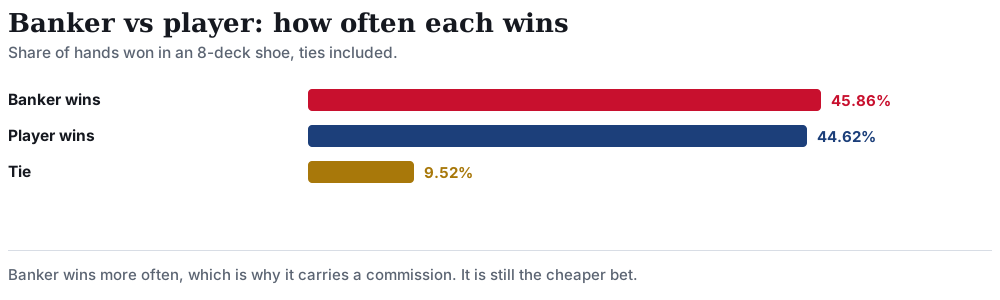
The baccarat banker vs player question has a clear answer on a standard table, and a smaller one than most guides admit. Banker wins 45.86% of rounds against the Player's 44.62%, pays a 5% commission on wins, and still ends up with the lower house edge: 1.06% against 1.24%. This page shows where that gap comes from, what it costs you in pounds at £5 to £100 stakes, why it reverses on no-commission tables, and why streaks, switching and patterns do not move it at all.
Baccarat banker vs player: the short verdict
On a standard punto banco table with a 5% commission, back Banker. It is the cheapest bet in the game. On a no-commission table, where a Banker win on 6 pays half, back Player instead, because the house has quietly moved its margin onto the Banker side. Ignore the Tie for this decision entirely; it costs many times more than either. If the bets themselves are new to you, our guide on how to play baccarat explains them from the first card.
That is the whole answer, and the margin between the two sides is small enough that choosing Player on a standard table is not a mistake worth losing sleep over. For where to place either bet, the homepage ranks licensed baccarat sites uk by licence, limits and terms.
Banker vs player in baccarat: the numbers side by side
Everything below is for an eight-deck shoe, the usual format online and in British casinos. The figures are the standard values published by Wizard of Odds, and every percentage on this page is derived from them.
| Measure | Banker | Player |
|---|---|---|
| Wins (ties included) | 45.86% | 44.62% |
| Loses | 44.62% | 45.86% |
| Pushes on a tie | 9.52% | 9.52% |
| Wins when ties are ignored | 50.68% | 49.32% |
| Pays on a win | 0.95 to 1 | 1 to 1 |
| House edge per round | 1.06% | 1.24% |
| House edge per decided round | 1.17% | 1.37% |
The last row needs a word. Because roughly one round in ten is a tie and your stake simply comes back, the house edge per round understates what you lose on rounds that actually settle. Divide by the 90.48% of rounds that produce a winner and the Banker costs 1.17% of each decided bet, the Player 1.37%. Both ways of counting tell the same story; just do not compare a figure from one with a figure from the other, which is how some sites end up quoting numbers that seem not to match.
Baccarat banker vs player: why Banker wins more often
Nothing about the cards favours one side. Both hands draw from the same shoe and start with two cards each. The difference is entirely in the drawing rules. The Player hand follows a short rule based only on its own total. The Banker hand moves second and, whenever the Player takes a third card, gets to see that card before deciding whether to draw.
That second look is worth a little over one percentage point of win rate. It is not a large edge in any single round, but repeated across a shoe it is enough that a casino could not pay Banker at even money without losing. Every row of the Banker's chart, with worked hands, is set out on our page about the baccarat third card rule. You do not need to know it to bet well, only that the advantage is built into the rules and does not depend on luck or timing.
Does Banker winning more often mean Banker is due?
No. A slightly higher long-run frequency tells you nothing about the next round. Banker can lose six in a row, and Player can win six in a row, without anything being wrong with the shoe or the software.
Banker or player bet: where the Tie fits in
When the hands finish level, a Banker or Player bet neither wins nor loses. That push is why the win and loss rows in the table above do not add up to 100%. It also explains a quirk of the decision: the Tie does not hurt either side, it simply delays the result, so it plays no part in choosing between Banker and Player.
The Tie as a bet in its own right is a separate matter. At 8:1 it carries a house edge of 14.36%, more than thirteen times the Banker's, and even the friendlier 9:1 version sits at 4.84%. If you want the full comparison of those two payouts, our page on the baccarat tie bet works through both. For the Banker against Player question, treat ties as rounds that did not happen.
Hedging Banker and Player at once
Backing both sides in the same round guarantees you lose a little: on a Banker win you pay commission, and on a Player win you break even on the pair. You lose nothing on a tie, gain nothing either, and the only result is a slower drain. Bonus terms often list betting opposite outcomes as irregular play, so read the conditions before trying it with bonus money.
Baccarat banker vs player: side bets that ride on each hand
Several side bets attach to one side rather than the other: a Banker Pair or a Player Pair, or a Dragon Bonus placed on either hand. They pay more than the main bets and carry far higher house edges, and backing the Banker side of a side bet does not inherit the Banker's main-bet advantage. Each one has its own maths, and our guide to baccarat side bets sets out what they pay and cost.
The practical point is simple. Once you have settled on Banker for its lower edge, adding a side bet every round can easily cost more than the entire gap you gained by choosing Banker over Player.
Baccarat banker vs player: what the 5% commission does
The commission is the casino's answer to the Banker's better win rate. On a winning £10 Banker bet you are paid £9.50 instead of £10. Losing Banker bets pay nothing extra, and pushes are commission-free.
The commission in one calculation
Per £100 staked on Banker over many rounds, you win about £45.86 of rounds and collect 95% of that, roughly £43.57, while losing about £44.62. The net is a loss of about £1.06, which is where the 1.06% house edge comes from. Do the same for Player and you collect £44.62 in winnings against £45.86 in losses, a net loss of about £1.24.
The break-even commission
Working backwards from those win rates, the Banker bet would only reach a zero edge if the commission fell to about 2.7%. At 5% the house keeps roughly 1% on the bet; at anything below about 2.7% it would be giving money away, which is why you will not find a standard licensed table charging that little. If a game advertises a reduced commission, read its help panel to see what it has changed elsewhere to pay for it.
Commission on land tables
Online the 5% is simply taken off your winnings at payout. On a land table the croupier may track the commission you owe with markers and collect it at the end of the shoe or when you leave. It is the same 5% either way, but on a long session it can add up to a noticeable sum, so keep it in mind when you count your chips.
Baccarat banker vs player: no-commission tables
No-commission games remove the 5% and replace it with one exception: a Banker win with a total of 6 pays 1 to 2, half your stake, instead of even money. Every other Banker win pays in full.
That single exception takes more than the commission did. The Banker's house edge rises to 1.46%, while the Player bet is unchanged at 1.24%. On these tables the answer to banker vs player flips, and Player becomes the cheaper side. The variations of the format, and how to recognise one in a lobby, are covered in our guide to no commission baccarat.
| Table type | Banker edge | Player edge | Cheaper side |
|---|---|---|---|
| Standard, 5% commission | 1.06% | 1.24% | Banker |
| No commission, Banker 6 pays 1 to 2 | 1.46% | 1.24% | Player |
Before you sit down, check which kind of table you are at. A no-commission table often looks identical to a standard one apart from a line in the rules panel, and backing Banker there by habit costs you more than backing Player would.
Baccarat banker vs player: streaks, switching and other myths
A lot of baccarat folklore is about when to switch sides. None of it changes the edge.
- Following the streak: betting Banker because Banker won the last four rounds does not raise its chance of winning the fifth.
- Betting against the streak: the opposite approach fails for the same reason.
- Switching on a chop: alternating results are just as random as runs.
- Waiting for Player to be due: no side is ever owed a win.
Progressive staking plans that raise your bet after losses or wins do not change any of this either. They rearrange when you win and lose, not how much the game takes on average, a point our guide to baccarat betting systems works through system by system.
The results grid on a live table encourages exactly this kind of side-switching, with its columns of red and blue. It records what has happened in the shoe, and that is all. Reading it is harmless; betting on it is where the money goes, because no arrangement of past results tells you which side the next card favours.
Baccarat banker vs player: the cost in pounds at UK stakes
Percentages hide how small the gap really is. The table shows the expected cost of 100 rounds at a flat stake, using the per-round house edges above.
| Flat stake | Total staked over 100 rounds | Expected cost on Banker | Expected cost on Player | Difference |
|---|---|---|---|---|
| £5 | £500 | £5.30 | £6.20 | £0.90 |
| £10 | £1,000 | £10.60 | £12.40 | £1.80 |
| £25 | £2,500 | £26.50 | £31.00 | £4.50 |
| £100 | £10,000 | £106.00 | £124.00 | £18.00 |
Why a session can still go either way
Those expected costs are averages over a very long run. In a single session, chance swamps them. Working from the same probabilities, the standard deviation of 100 rounds at £10 a round is around £93 on Banker and £95 on Player. A session that ends £90 up or £90 down is ordinary, and the £1.80 difference between the two bets is invisible inside it. Choose Banker because it is cheaper over time, not because it will make tonight better. The full set of probabilities behind these numbers is on our page about baccarat odds.
Baccarat banker vs player: live tables and RNG games
The comparison does not change between a live studio and a software table. Both deal punto banco to the same drawing rules, so the win rates, the commission and the two house edges are identical. What differs is the experience around the bet.
On a live table you have a fixed betting window, shown by a countdown, and a croupier deals from a physical shoe that is cut and reshuffled at intervals. On an RNG table the software shuffles for every round and waits for you to press deal, so you play more rounds per hour if you let it. That pace matters more than people expect: the house edge applies to every round, so a faster game at the same stake costs more per hour on either side. Choosing Banker saves you 18p per £100 staked; playing half as many rounds saves you half your expected losses.
Table minimums and maximums also differ by game and by casino, and they are listed in each table's information panel rather than in any general guide. Check them before you choose a stake, especially if you plan to play for a while.
Baccarat banker vs player: when Player is the sensible choice
Banker is cheaper on a standard table, but there are honest reasons to pick Player.
You are at a no-commission table
As above, Player has the lower edge there. This is the one case where the maths clearly points the other way.
You prefer round numbers
Player pays even money, so a £10 stake returns £20 on a win with no fractions to track. Some players like that clarity, and the cost of choosing it is under 2p per £10 bet on average.
You simply enjoy it more
Baccarat is entertainment with a price attached. If backing Player makes a session more enjoyable for you, paying 0.18% more for that is a reasonable choice, provided you know it is a choice.
Baccarat banker vs player: a simple plan for a session
None of this beats the game; it just keeps the cost at the minimum the rules allow.
- Check the table type in the help panel: standard commission or no commission.
- Back Banker on a standard table, Player on a no-commission table.
- Keep a flat stake you can afford to lose many times over.
- Leave the Tie and side bets alone, or treat them as a deliberate extra cost.
- Set your budget before you start, and use your account's deposit limit if you want it enforced.
- Ignore streaks and the results grid when choosing a side.
Play only if you are 18 or over. If betting stops being fun, GAMSTOP can block you from every UK-licensed online casino at once, and the National Gambling Helpline is free on 0808 8020 133 at any hour.
Baccarat banker vs player: common questions
Is it better to bet on the Banker or the Player in baccarat?
On a standard table with a 5% commission, Banker is better, with a house edge of 1.06% against 1.24% for Player. On a no-commission table, where a Banker win on 6 pays half, Player is better because the Banker edge rises to 1.46%.
Why does the Banker bet charge a commission?
Banker wins 45.86% of rounds against 44.62% for Player, because its drawing rules let it react to the Player's third card. Paying even money on that would hand players an edge, so casinos keep 5% of Banker winnings.
Does the Banker win more often than the Player?
Yes, slightly. With ties left out, Banker wins about 50.68% of decided rounds and Player about 49.32%. That gap is small enough that either side can win long runs in any session.
How much difference does choosing Banker make?
Over 100 rounds at £10, the expected cost is about £10.60 on Banker and £12.40 on Player, a difference of about £1.80. Normal session swings are far larger than that, so the benefit only shows over a very long run.
Should I switch between Banker and Player based on streaks?
No. Each round is independent of the last in any way you can use, so a streak does not make either side more or less likely to win next. Switching on patterns changes nothing about the house edge.
What happens to a Banker or Player bet when the hand ties?
Your stake is returned in full and no commission is charged. Only a bet on the Tie itself is paid when the hands finish level.
Can I bet on Banker and Player at the same time?
Most tables allow it, but you lose a little every time Banker wins because of the commission, and you never come out ahead. Many bonus terms also treat betting both sides as irregular play.