


Baccarat Third Card Rule 2026 - Player and Banker Charts
Every drawing decision in punto banco, laid out as charts and tested on real hands.
We earn a commission on some links on this page. It is one input to the order, and it never changes the figures shown. Every operator on our board is listed as licensed by the UK Gambling Commission, so GAMSTOP self-exclusion covers them.
The baccarat third card rule decides, without any input from you, whether the Player or Banker hand takes one more card. It works in a fixed order: check for a natural, apply the Player rule, then apply the Banker tableau, which can depend on the Player's third card. Below you will find both charts in full, the same chart turned round the way many dealers learn it, six hands worked through, a few memory aids that are actually correct, and the reason the rule exists at all. The charts were checked against Wizard of Odds.
Baccarat third card rule: the short answer
Three checks run in sequence after the first four cards are out. If either hand totals 8 or 9, nobody draws. Otherwise the Player hand draws on 0 to 5 and stands on 6 or 7. Then the Banker acts: if the Player stood, the Banker draws on 0 to 5; if the Player drew, the Banker looks up its own total against the Player's third card. That last step is the only part with any complexity, and it is all on this page. If you are new to the game, our guide on how to play baccarat covers card values and the three bets first.
None of it is optional. In punto banco, the version on every UK casino site, neither you nor the croupier chooses anything, and the software or the dealer applies the same tableau every round. Picking a table comes first, and the shortlist of licensed baccarat sites uk on our homepage is the place to start.
Baccarat third card rule: when a natural stops the draw
Before any drawing rule applies, the table checks both two-card totals for a natural. An 8 or a 9 on two cards, for either side, freezes the round. The other hand does not draw even if it holds 0, and the result is decided on the four cards already showing.
- Player 9, Banker 7: Player wins, no cards drawn.
- Player 2, Banker 8: Banker wins, and the Player's 2 never gets its third card.
- Player 8, Banker 8: a tie, settled at once.
- Player 9, Banker 8: both are naturals and the 9 wins.
The natural check matters because it is the one rule that overrides both drawing charts. Plenty of players learn the Player rule and forget it, then puzzle over why a Player 3 stood. It did not stand; the Banker's natural ended the hand first.
Baccarat third card rule: the Player hand
The Player side has the simplest rule in the game. It ignores the Banker's cards completely and looks only at its own total.
| Player two-card total | Action |
|---|---|
| 0, 1, 2, 3, 4, 5 | Draws a third card |
| 6, 7 | Stands |
| 8, 9 | Natural: round ends, nobody draws |
A Player 5 always draws in punto banco. That is worth stating because it is the line that differs from older forms of the game, where whoever held the Player hand could choose. Here the choice has been removed.
Baccarat third card rule: the Banker when Player stands
If the Player stood on 6 or 7, there is no Player third card to react to, and the Banker uses a rule that mirrors the Player's own.
| Banker two-card total | Action when Player stood |
|---|---|
| 0 to 5 | Draws |
| 6, 7 | Stands |
This case is easy to skip past, and several charts online leave it out, which makes a Banker 5 drawing against a standing Player look like an error. It is not. Without a Player third card, the conditional part of the tableau never comes into play.
Baccarat third card rule: the full Banker drawing table
When the Player has drawn, the Banker's decision depends on two things: its own two-card total, and the point value of the Player's third card (with tens and picture cards counted as 0). The chart below is the standard tableau for punto banco, and it matches the drawing rules published by Wizard of Odds.
| Banker total | Banker draws if Player's third card is | Banker stands if Player's third card is |
|---|---|---|
| 0, 1, 2 | Any card | Never stands |
| 3 | 0, 1, 2, 3, 4, 5, 6, 7, 9 | 8 |
| 4 | 2, 3, 4, 5, 6, 7 | 0, 1, 8, 9 |
| 5 | 4, 5, 6, 7 | 0, 1, 2, 3, 8, 9 |
| 6 | 6, 7 | 0, 1, 2, 3, 4, 5, 8, 9 |
| 7 | Never draws | Any card |
Baccarat third card rule: how it gives Banker the edge
The Banker acts second and acts with information. When the Player draws, its third card is face up, and the tableau uses that card to decide, row by row, whether a draw is worth taking from the Banker's position. The Player gets no such help. Over an eight-deck shoe that tilts the results: Banker wins 45.86% of rounds, Player 44.62%, and 9.52% are ties.
A casino cannot pay even money on a hand that wins more often than its opponent, so it takes 5% of Banker winnings. That commission turns the Banker's advantage back into a house edge of 1.06%, still a little below the Player's 1.24%. Whether that small difference should decide which side you back, and what it costs at real UK stakes, is covered in our guide to baccarat banker vs player.
Why understanding the rule does not help you win
Knowing the tableau lets you follow a hand and spot a mistake, but it gives you nothing to act on. You bet before any card is seen, and the drawing rules then run identically for every player at the table. There is no point in the round where knowing the chart changes a decision you make.
Baccarat third card rule: why it exists
Baccarat was not always played to a fixed chart. In the older French game, the hands belonged to actual players, and decisions about drawing were partly theirs. In chemin de fer, the punter holding the Player hand on exactly 5 may choose whether to draw, and the player acting as banker, who is staking their own money against the table, has some say in a few borderline spots too. Our page on chemin de fer baccarat explains how that version runs and why it survives mainly in private rooms.
Punto banco, the casino-banked form that reached Las Vegas by way of Latin America, removed every one of those choices. Once the house is the bank, any room for judgement becomes a problem: a dealer could influence results, and players could accuse the casino of doing so. A fixed tableau solves both. Every hand plays out the same way no matter who deals it or who bets on it, which is also what lets an RNG game reproduce the live game exactly.
The particular choices in the chart are not arbitrary either. The Banker rows are close to what a Banker trying to maximise its own results would choose, given what the Player's third card reveals. That is why the chart looks lopsided, and why it ends up favouring the Banker side.
Third card rule in baccarat: the chart turned round
Croupiers often learn the tableau from the other direction: look at the Player's third card first, then know at a glance how high the Banker can be and still draw. It is the same rule, just indexed differently, and some players find it the easier one to hold in their heads.
| Player's third card | Banker draws on | Banker stands on |
|---|---|---|
| 2 or 3 | 0 to 4 | 5 to 7 |
| 4 or 5 | 0 to 5 | 6 and 7 |
| 6 or 7 | 0 to 6 | 7 |
| 8 | 0 to 2 | 3 to 7 |
| Ace, 9, 10 or picture card | 0 to 3 | 4 to 7 |
Read this way, the shape of the rule is easier to see. The Banker keeps drawing highest, all the way up to 6, when the Player's third card was a 6 or 7, and stops earliest, from 3 upwards, when it was an 8. Every other card sits somewhere between those two extremes.
Baccarat third card rule: six hands worked through
One thing first: the tableau affects some bets on the layout and not others. Pair bets are settled on the first two cards of a hand, so the drawing rule never touches them. Others, such as the Dragon Bonus, depend on the final totals and on whether a hand was a natural, so a third card can make or break them. The rules and payouts for each are on our page about baccarat side bets.
Each of these hands tests a different row of the chart. Ten-value cards count as 0 throughout.
Banker on 3 against a Player 8
Player holds a Queen and a 4, a total of 4, and draws an 8, finishing on 2. Banker holds a 2 and an Ace, a total of 3. A Banker 3 draws on everything except an 8, and an 8 is what arrived, so the Banker stands. Banker 3 beats Player 2.
Banker on 4 against a Player Ace
Player holds a 5 and a King, a total of 5, draws an Ace, and moves to 6. Banker holds a 9 and a 5, which makes 14 and counts as 4. The Ace counts as 1, and a Banker 4 only draws on a 2 to 7, so it stands. Player 6 beats Banker 4.
Banker on 5 against a Player 4
Player holds a 3 and a Jack, a total of 3, and draws a 4 for 7. Banker holds a 7 and an 8, making 15, which counts as 5. A Banker 5 draws on 4 to 7, so it takes a card: a 3. The Banker finishes on 8 and wins.
Banker on 6 against a Player 6
Player holds a 4 and an Ace, a total of 5, and draws a 6, which takes it to 11 and a value of 1. Banker holds two 3s for 6. A Banker 6 draws only against a Player 6 or 7, and this is one of those times. It draws a 2 and finishes on 8, beating the Player's 1.
Banker on 5 when the Player stands
Player holds a 4 and a 3, a total of 7, so it stands. Banker holds a 10 and a 5. With no Player third card, the Banker simply draws on 0 to 5. It takes a 2 and lands on 7. Seven against seven is a tie, so Player and Banker stakes are returned; only the baccarat tie bet is paid on a hand like this.
Banker on 7 against a Player 9
Player holds a 2 and a 3, a total of 5, and draws a 9, finishing on 14, which counts as 4. Banker holds a 6 and an Ace, a total of 7. A Banker 7 never draws, whatever the Player took. Banker 7 beats Player 4.
Baccarat third card rule: memory aids that hold up
You do not need to memorise the tableau to play, since it is applied for you. If you want to follow a live hand in real time, though, these shortcuts are accurate, unlike some that circulate online.
- Player: 5 or under draws, 6 and 7 stand.
- Banker 0, 1 or 2: always draws. Banker 7: never draws.
- Banker 3: draws unless the Player's third card was an 8.
- Banker 4, 5 and 6: the drawing window always ends at 7 and starts at 2, 4 and 6 respectively. Each step up in Banker total trims two cards off the bottom.
- No Player third card: the Banker copies the Player rule.
That fourth line covers the three rows people get wrong most often. A Banker 4 draws on 2 to 7, a Banker 5 on 4 to 7, a Banker 6 on 6 and 7. Learn the starting numbers 2, 4, 6 and the fixed ceiling of 7, and those three rows need no further thought.
Baccarat third card rule: other variants and checking a hand
Most online variants built on punto banco keep this exact chart: mini tables, fast-dealt live formats and no-commission games change the pace, the table size or how a Banker win is paid, not who draws. Always open the help panel on an unfamiliar game, though. If a variant changed the drawing rules, its rules page would say so, and that page, not a general chart, is what governs the table you are sitting at.
Checking a dealt hand yourself
On a live stream, the hand is drawn by a real croupier from a shoe, and mistakes are rare but possible. On an RNG table, the software applies the chart automatically. Either way, you can check any finished hand in seconds: confirm there was no natural, confirm the Player drew on 0 to 5, then read the Banker's total against the Player's third card in the chart above. Every licensed game also records its round history, so a hand you think was wrong can be raised with the casino's support team with the round number attached.
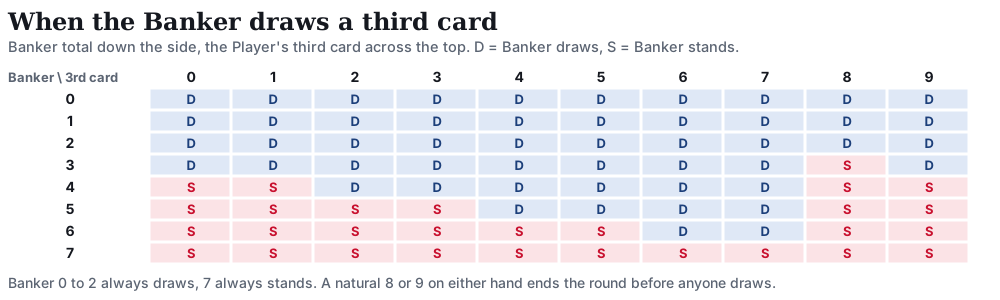
The same tableau as a draw and stand grid
Some players find a grid quicker to scan. Read across from the Banker total to the column for the Player's third card: D means the Banker draws, S means it stands.
| Banker | 0 | 1 | 2 | 3 | 4 | 5 | 6 | 7 | 8 | 9 |
|---|---|---|---|---|---|---|---|---|---|---|
| 0 to 2 | D | D | D | D | D | D | D | D | D | D |
| 3 | D | D | D | D | D | D | D | D | S | D |
| 4 | S | S | D | D | D | D | D | D | S | S |
| 5 | S | S | S | S | D | D | D | D | S | S |
| 6 | S | S | S | S | S | S | D | D | S | S |
| 7 | S | S | S | S | S | S | S | S | S | S |
Does the rule make card counting worthwhile?
Because the tableau is fixed, the cards left in the shoe do shift the odds by tiny amounts as a shoe is dealt, and that is the theory behind baccarat card counting. In practice the shifts are too small and too rare to overcome the house edge, and RNG tables typically reshuffle after every round, so the third card rule is something to understand, not something to exploit.
Baccarat third card rule: common questions
What is the third card rule in baccarat?
It is the fixed set of rules that decides whether the Player and Banker hands take a third card. The Player draws on 0 to 5 and stands on 6 or 7, and the Banker draws according to its total and, if the Player drew, the Player's third card. Nobody draws when either hand has a natural 8 or 9.
Do I have to decide whether to draw a third card?
No. In punto banco the rule is applied automatically by the croupier or the software, and you only choose your bet. A choice to draw only exists in older forms such as chemin de fer.
When does the Banker draw on 3?
A Banker 3 draws on every Player third card except an 8. If the Player stood on 6 or 7, a Banker 3 draws as well, because the Banker draws on 0 to 5 when there is no Player third card.
Does a Player total of 5 draw or stand?
It always draws in punto banco. The Player stands only on 6 or 7, or when either hand has a natural.
Why does the Banker have its own drawing chart?
The Banker acts second, so its chart uses the Player's third card to decide whether drawing is worthwhile. That information is what makes the Banker win slightly more often, and the 5% commission on Banker wins is there to offset it.
Is the third card rule the same online and at a live table?
Yes. Standard RNG tables and live punto banco tables use the same tableau, and fast or no-commission variants keep it too. Check the help panel of any unusual game, because its rules page is what governs that table.
Do I need to memorise the third card rule?
No, because the table applies it for you on every hand. Knowing it helps you follow a round and check a result, but it does not change the odds of any bet.